Just about everyone knows the basic idea behind the Laffer curve: at both 0% and 100% taxation, the government gets no tax revenues, meaning that decreasing taxes can theoretically lead to increased revenues. The resultant theory of supply-side economics helped catapult Ronald Reagan to the Presidency in the 1980s, and controlled GOP economic policy for a generation. It also crippled economic conservatism on the national stage, perhaps beyond our ability to heal.
But wait, you say. Isn't lower taxation in line with the goals of fiscal conservatism? Well, yes and no. To economic conservatives, lower taxation is a desirable but secondary byproduct of lower spending. This unremarkable revelation came to me when I was thinking about the California budget deficit (see two posts down) and realized that the debate was framed incorrectly.
We don't have a budget deficit. Wait, don't leave, let me explain! The term "budget deficit" implies that the problem is insufficiency; specifically, that tax revenues are insufficient to cover spending programs. But this is an absurd way to view the problem. For starters, tax revenues have consistently increased relative to inflation over any period of time you care to name. Some data: here are historical records of tax revenues over the last 75 years and an inflation calculator. I challenge readers to find any time period 10 years or longer where real tax revenues decreased. Factor in population growth if you like; it doesn't matter. America's government, just like California's, has generally taken in more money from its citizens each year.
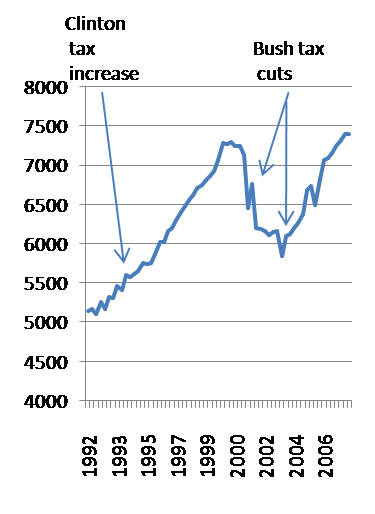
Furthermore, tax revenue is, by and large, the independent variable in this equation. The only government that has absolute control over how much money it gets is a dictatorship. More to the point, changes in tax policy don't have any real long-term effects on tax revenues, which have hovered around 18% of GDP for at least 30 years and probably much longer (here's some historical GDP data for curious readers to play with). George Bush's much-reviled (or much-vaunted, in the right crowd) tax cuts led to a short, sharp fall (>10%) in tax revenues as a percentage of GDP between 2000 and 2004 - but by 2007, revenues were right back on the long-term trend line. The limited effect of political decisions on tax revenues is amply illustrated by this graph from Paul Krugman's 1/16/08 NY Times editorial, "Taxes and revenues - another history lesson." Krugman contends that this graph shows the benefits of increasing taxes, but fails to note that the graph correlates much more closely to GDP than to either Clinton's or Bush's tax policies.
Clearly, tax revenues aren't the problem - they're perhaps the last consistent performer in Washington. Hence I repeat my point: we do not have a budget deficit. Rather, what we have is a spending surplus. Basic economics teaches us that we have limited resources to satisfy unlimited needs; but when politicians can punt scarcity into the national debt, they tend to spend beyond their means in attempting to deliver instant gratification of their constituents' demands. This leads right into the basic tenet of fiscal conservatism: the key to responsible governance is restraint in government spending. In short, the problem isn't how much money government takes in, it's how much money government puts out.
In this sense, the Laffer curve is nothing but trouble for economic conservatives. Here's the core of the problem: the Laffer curve diverts focus from the problem of excessive spending by dangling the dual carrot of lower taxes and higher revenues. Supply-side economics is only useful insofar as it suggests that raising taxes is not necessarily an efficient revenue collection instrument; taken any further, it generally becomes an argument for lower taxes in order to spend more. Hence absurdities like conservatives compromising with liberals by spending money on social programs as well as the war effort; like the "compromise" between tax cuts and increased spending in the recent trillion-dollar stimulus bill; like the generation-old tendency of the opposition party to accuse the majority party of indiscriminate spending, ignoring its own indiscretions when it was the majority party (blatantly evident in both parties over the past three years). Rather than measuring our wish-list against our budget, we measure our budget against our wish-list. Then we wonder how it is that so many people bought houses they couldn't afford to keep, caught up in the dream of a permanent real-estate boom.
Sunday, March 8, 2009

Tuesday, March 3, 2009
Perspective on Religion, Prayer, and Meditation
I recently received a questionnaire from a classmate related to a class assignment, and I feel like my responses were worthwhile enough that I should lengthen my memory of them by posting them here. Some of the answers are very shallow; I plan to contemplate the questions further when I have time.
Prayer (meditation) is a process of stillness, focus, awareness, contemplation, and understanding - in that order.
[secondary] Prayer is stress relief, an emotional buffer between my raw feelings and my actions.
I pray (meditate) when I am most emotional, and when I am least emotional. When I am intensely emotional, I seek to calm my feelings and restore my self-control. When I am emotionless, I seek to enter the process described above through stillness.
I quiet myself, assume a posture (no specifics other than tucked chin and straight back; it's pretty spontaneous) and focus on my breathing.
If I pray to anyone, I suppose it's myself. In a sense, I pray that I may improve myself.
Intermittently over the past five-ish years, recently increasing in frequency. I now pray (meditate) in some fashion on most days.
No, and no.
I am most spiritual when I am surrounded by my own thoughts. In that sense, I am always alone when I am spiritual, even though I may be with other people.
Because I was not brought up in a religious context, I am not predisposed to believe in a higher power, which precludes a belief in most religions. When it comes to my worldview, I value the empirical over the hypothetical, the descriptive over the normative, the real over the ideal; as such, I prefer to restrict my belief in the supernatural and/or transcendent. Finally, the material plane satisfies my capacity for wonder, so that I have no real desire to add a divine element to the mix. The causes and consequences of humanity interest me more than the causes and consequences of deities.
While going to a religious school has certainly opened my eyes to the possibilities of faith, I remain unwilling to circumscribe my worldview with religious doctrine. To adopt religion seems a limited and limiting way of life. At this time, the most religion I would allow into my life would be the admission of a higher power (Deism) mixed with elements of philosophy and meditation from various Eastern religions. And at this point, I think my beliefs would be most accurately described as agnostic, which is a shift from my atheism prior to entering Bellarmine.
1. What is prayer to you? What is your definition of prayer?
Prayer (meditation) is a process of stillness, focus, awareness, contemplation, and understanding - in that order.
[secondary] Prayer is stress relief, an emotional buffer between my raw feelings and my actions.
2. Why do you pray?
I pray (meditate) when I am most emotional, and when I am least emotional. When I am intensely emotional, I seek to calm my feelings and restore my self-control. When I am emotionless, I seek to enter the process described above through stillness.
3. What form does your prayer take?
I quiet myself, assume a posture (no specifics other than tucked chin and straight back; it's pretty spontaneous) and focus on my breathing.
4. To whom do you pray? What is your image of God?
If I pray to anyone, I suppose it's myself. In a sense, I pray that I may improve myself.
5. How often do you pray?
Intermittently over the past five-ish years, recently increasing in frequency. I now pray (meditate) in some fashion on most days.
6. Do you feel that God ever communicates to you? How?
7. Have you ever had a time when you felt that one of your prayers was answered? Describe the incident. If not, is there a time where you feel or felt close to God?
No, and no.
8. At what point do you feel most spiritual? With whom? When?
I am most spiritual when I am surrounded by my own thoughts. In that sense, I am always alone when I am spiritual, even though I may be with other people.
9. Why are you religious (or not)?
Because I was not brought up in a religious context, I am not predisposed to believe in a higher power, which precludes a belief in most religions. When it comes to my worldview, I value the empirical over the hypothetical, the descriptive over the normative, the real over the ideal; as such, I prefer to restrict my belief in the supernatural and/or transcendent. Finally, the material plane satisfies my capacity for wonder, so that I have no real desire to add a divine element to the mix. The causes and consequences of humanity interest me more than the causes and consequences of deities.
10. Do you want to be religious or are you pushed otherwise? Why?
While going to a religious school has certainly opened my eyes to the possibilities of faith, I remain unwilling to circumscribe my worldview with religious doctrine. To adopt religion seems a limited and limiting way of life. At this time, the most religion I would allow into my life would be the admission of a higher power (Deism) mixed with elements of philosophy and meditation from various Eastern religions. And at this point, I think my beliefs would be most accurately described as agnostic, which is a shift from my atheism prior to entering Bellarmine.
California's Budget Crisis and the Economic Stimulus
My father often tells me that he has only ever seen one graph in the San Jose Mercury News that concisely conveyed relevant information without distortion. The graph was in an article from the late '90s discussing California's budget deficit, and it graphed the California government's inflation-adjusted revenues and expenditures over time. The notable point to be recognized, my father would say, is that although both lines steadily increased as time passed, the line representing expenditures was consistently higher than the line representing tax revenues. California's tax revenues had increased at a rate significantly outstripping inflation, meaning that in any given year, Sacramento politicians had more real resources than the previous year--yet the government's response was simply to keep spending beyond its means. Worse, my father would tell me, California was making long-term spending commitments, out to a decade or more, based on the assumption that these trends would continue, that the tech boom was a permanent phenomenon. This article, said my father, plainly showed the seeds sown for a California crisis down the road.
Of course, I'm not saying my father was some kind of genius just because his prediction is coming true. Anyone with the same information and a basic capacity to reason could have done the same, and many probably did. Still, I have to say, this sounds a lot like what my father's been saying:
I don't really agree with Bill Quick on that last point. The problem with California is that politicians based their spending commitments on the rose-colored glasses theory of economics. They planned based on an eternal boom, and it came back to bite them. Obama, on the other hand, knows the economy's tanking, and he's promoting spending in order to fix it. In other words, rather than being the fuel for spending (as in California), the economy is now the impetus for spending. As such, I don't think it's fair to say that Obama and the CA legislature are touting the same solution, because they've been working on different problems.
However, it is telling that when the economy was booming in California, the answer from the left was increases in social spending on education and healthcare, coupled with tightened environmental regulation under the recently established California EPA. And here is Obama's analysis of the economic crisis, taken from his recent not-State-of-the-Union speech to Congress:
(emphasis mine)
So Obama advocates increased spending on education, healthcare and the environment as partial solutions to the crisis (even accepting the nebulous connection between the former and the latter), while California Democrats advocate increased spending on education, healthcare and the environment as something to do with cash from boom times. It's almost as if their drive for this social spending is completely indifferent to economic concerns, and all the wailing and gnashing of teeth over the economic crisis is just a means to push through the left-wing political agenda. "Never let a good crisis go to waste" and all that.
Of course, I'm not saying my father was some kind of genius just because his prediction is coming true. Anyone with the same information and a basic capacity to reason could have done the same, and many probably did. Still, I have to say, this sounds a lot like what my father's been saying:
California spends far more than it takes in, despite having some of the highest taxes in the United States. It is hostile to business, and the middle class is fleeing in droves. It runs huge deficits every year, yet the Dem dominated legislature refuses to do anything effective to cut spending.
Now one in ten Californians is unemployed. Does any of this sound familiar? It should. It’s what Obama and the Democrats have in mind as a “solution” for the rest of the country.
I don't really agree with Bill Quick on that last point. The problem with California is that politicians based their spending commitments on the rose-colored glasses theory of economics. They planned based on an eternal boom, and it came back to bite them. Obama, on the other hand, knows the economy's tanking, and he's promoting spending in order to fix it. In other words, rather than being the fuel for spending (as in California), the economy is now the impetus for spending. As such, I don't think it's fair to say that Obama and the CA legislature are touting the same solution, because they've been working on different problems.
However, it is telling that when the economy was booming in California, the answer from the left was increases in social spending on education and healthcare, coupled with tightened environmental regulation under the recently established California EPA. And here is Obama's analysis of the economic crisis, taken from his recent not-State-of-the-Union speech to Congress:
The fact is, our economy did not fall into decline overnight. Nor did all of our problems begin when the housing market collapsed or the stock market sank. We have known for decades that our survival depends on finding new sources of energy. Yet we import more oil today than ever before. The cost of health care eats up more and more of our savings each year, yet we keep delaying reform. Our children will compete for jobs in a global economy that too many of our schools do not prepare them for. And though all these challenges went unsolved, we still managed to spend more money and pile up more debt, both as individuals and through our government, than ever before.
(emphasis mine)
So Obama advocates increased spending on education, healthcare and the environment as partial solutions to the crisis (even accepting the nebulous connection between the former and the latter), while California Democrats advocate increased spending on education, healthcare and the environment as something to do with cash from boom times. It's almost as if their drive for this social spending is completely indifferent to economic concerns, and all the wailing and gnashing of teeth over the economic crisis is just a means to push through the left-wing political agenda. "Never let a good crisis go to waste" and all that.
Saturday, January 31, 2009
A Working Government
"The question we ask today is not whether our government is too big or too small, but whether it works."
Volokh Conspiracy's Ilya Somin writes a thoughtful post with this quotation from Obama's inauguration speech as the vehicle. Professor Somin argues that "[Government] has systematic flaws that justify a presumption against it," basically defending the virtues of small government. It's a great piece of work, and Volokh has a great comment culture, so read the whole thing. However, I think Somin passes over the fundamental problem with this statement, with only a passing reference to what I consider its biggest flaw: "Who could possibly be against government when it 'works'?"
My problem with Obama's statement is not that it has no general presumption about limiting government power, but rather that it has no general presumptions at all. The only positive declaration implied by the statement is that what "works" is important; but without any idea of what "working" is, how are we the listeners supposed to learn anything from this statement? Without any semantic content in the statement, listeners are free to attach any interpretation they want to it, making Obama into a tabula rasa for everyone's hopes and fears. Everyone's in favor of things working; the problem is that nobody can agree on how best to arrive at the "working" conclusion. Obama's statement, like many before it, expresses the obvious and skips all the controversy that comes attached.
For reference, here is the full transcript of Obama's inaugural address. The statement in question can be found on page 2.
Saturday, November 22, 2008
VI Day
Zombietime wishes to commemorate the remarkable progress in the last year or so in Iraq by setting today, the 22nd of November, as Victory in Iraq day. I agree, but read the whole thing.
Wednesday, November 5, 2008
Where next?
From Representative Jeff Flake (R-AZ), via The Volokh Conspiracy, comes an agenda for Republicans in the wake of the '08 elections:
To make the obvious pun, Flake's no flake; that was a good message. A few problems, though:
The first problem that I spot with this is that earmarks are essentially irrelevant numbers-wise. Regardless of the moral high ground of being anti-pork, it's hard to get excited when one of the main pillars of a platform is "just" $17 billion, 2% of the nation's discretionary spending. Eliminating all of them would just barely keep the budget flat for one year. Without a better reason to make this an issue, the GOP should just leave it alone - all the more so since 2000-2006 saw so much GOP earmarking that their credibility is ruined on the issue. It seems like an issue that should only be pursued once the GOP wins back a majority - then an anti-earmark stance will actually carry some weight. Don't put the horse before the carrot, so to speak.
Second problem: when a conservative talks about free-market principles, voters will think "deregulation." And when they think of deregulation, they will connect it rightly or wrongly to the financial crisis. That's not a platform anyone can win on.
Third problem: by putting the Second Amendment right next to "strong national defense," Flake plays right into a fundamental paradox of the right wing that many voters see: that while conservatism is about limited government, conservatives often push for a stronger government and the curtailment of absolute freedom in the interest of security. When I say "curtailment of absolute freedom," I don't mean that Big Brother is now watching you and a wrong word will get you carted off to prison; I mean that the right wing will support legislation establishing the potential for a Big Brother system in times of conflict. Yes, the economy is important, perhaps more so than anything else from a strictly political standpoint. But if the Republican Party wants to reestablish credibility, it needs to start by explaining the seeming contradictions in its platform, and this is perhaps the biggest of them all. After we've established that the platform is consistent, THEN we can move on to consistently living up to it.
Update: On Volokh Conspiracy, this comment by Richard Aubrey caught my eye:
I hadn't thought of this at all. By using earmarks, the argument goes, Congressmen are able to break the political process and so get much more damaging legislation passed. I'd like to see some examples of this, but there's the potential to make earmarks a significant issue here. 'Course, the fact that this is the first I've heard of this line of thought shows how poorly anti-porkers are selling it...
I suggest that we return to first principles. At the top of that list has to be a recommitment to limited government. After eight years of profligate spending and soaring deficits, voters can be forgiven for not knowing that limited government has long been the first article of faith for Republicans.
Of course, it's not the level of spending that gets the most attention; it's the manner in which the spending is allocated. The proliferation of earmarks is largely a product of the Gingrich-DeLay years, and it's no surprise that some of the most ardent practitioners were earmarked by the voters for retirement yesterday. Few Americans will take seriously Republican speeches on limited government if we Republicans can't wean ourselves from this insidious practice. But if we can go clean, it will offer a stark contrast to the Democrats, who, after two years in training, already have their own earmark favor factory running at full tilt.
Second, we need to recommit to our belief in economic freedom. Adam Smith's "The Wealth of Nations" may be on the discount rack this year, but the free market is still the most efficient means to allocate capital and human resources in an economy, and Americans know it. Now that we've inserted government deeply into the private sector by bailing out banks and businesses, the temptation will be for government to overstay its welcome and force the distribution of resources to serve political ends. Substituting political for economic incentives is not the recipe for economic recovery. . . .
There are, of course, other pillars of the Republican standard -- strong national defense, support for traditional values and the Second Amendment -- but these are not areas where voters question Republican bona fides. In any event, as we have seen over the past several months, economic woes tend to subsume other concerns. We shouldn't complain. We can now play our strongest hand.
To make the obvious pun, Flake's no flake; that was a good message. A few problems, though:
The first problem that I spot with this is that earmarks are essentially irrelevant numbers-wise. Regardless of the moral high ground of being anti-pork, it's hard to get excited when one of the main pillars of a platform is "just" $17 billion, 2% of the nation's discretionary spending. Eliminating all of them would just barely keep the budget flat for one year. Without a better reason to make this an issue, the GOP should just leave it alone - all the more so since 2000-2006 saw so much GOP earmarking that their credibility is ruined on the issue. It seems like an issue that should only be pursued once the GOP wins back a majority - then an anti-earmark stance will actually carry some weight. Don't put the horse before the carrot, so to speak.
Second problem: when a conservative talks about free-market principles, voters will think "deregulation." And when they think of deregulation, they will connect it rightly or wrongly to the financial crisis. That's not a platform anyone can win on.
Third problem: by putting the Second Amendment right next to "strong national defense," Flake plays right into a fundamental paradox of the right wing that many voters see: that while conservatism is about limited government, conservatives often push for a stronger government and the curtailment of absolute freedom in the interest of security. When I say "curtailment of absolute freedom," I don't mean that Big Brother is now watching you and a wrong word will get you carted off to prison; I mean that the right wing will support legislation establishing the potential for a Big Brother system in times of conflict. Yes, the economy is important, perhaps more so than anything else from a strictly political standpoint. But if the Republican Party wants to reestablish credibility, it needs to start by explaining the seeming contradictions in its platform, and this is perhaps the biggest of them all. After we've established that the platform is consistent, THEN we can move on to consistently living up to it.
Update: On Volokh Conspiracy, this comment by Richard Aubrey caught my eye:
The earmarks are the key, the bribe, to get legislators to vote the required way, on the big things. A key doesn't weigh much, but heavy doors can be unlocked.
I hadn't thought of this at all. By using earmarks, the argument goes, Congressmen are able to break the political process and so get much more damaging legislation passed. I'd like to see some examples of this, but there's the potential to make earmarks a significant issue here. 'Course, the fact that this is the first I've heard of this line of thought shows how poorly anti-porkers are selling it...
Sunday, October 5, 2008
So why do I want to go to the school I indicated as my #1 choice?
The college application process is riddled with minor idiocies. Everything's a crapshoot at the higher levels - one college admission officer noted that if her university had rejected their entire incoming freshman class and taken the next batch instead, they'd have just as good a student body. Testing like that done on the SAT is notoriously bad at measuring much of anything. Heck, I took the Chemistry SAT II yesterday (I should have done it in May or June right after I finished AP Chemistry, but whatever), and the problems were perhaps marginally harder than the ones on the test I took to get out of General Science freshman year. 'Course, there were more of them, but that just means less time to check your answers. Do colleges really want to value people based on whether or not they slipped a 0 (or a hydroxide group) the first time round? Then there's the college info sessions, which were probably good before the inevitable "How can I get into Harvard?/How can I get my kid into Harvard?" crowd turned them into homogeneous, bland mixtures of random facts and balancing acts (don't want to drive any kids away with definite statements!).
By far the worst offenders, however, are the college essay questions. Your mileage may vary, of course; Chicago U's essays are notoriously quirky, for example. But I'm talking about the generic questions, and especially about one particular type of question: "Why do you want to go to School X? What makes School X a good place for you? Why are you applying to school X?" Here are some potential honest answers to this question:
"To get an education." (how many students have typed this on the page, stared at it, sighed, and deleted it so they could start over? H/t Dr. McNinja.)
"Look, I'm applying just in case I don't get into School Y over there." I'm always amused by how schools take it for granted that if a student applies, they MUST want to go there.
"School X is near where I live."
"Look, Mr. Stanford/MIT/Caltech/Harvard/Princeton/Yale/[your school here] admissions officer, it's obvious why I want to attend School X. Your school has an incredible program in the area of my interest. It has lots of challenging classes in other areas, too. Your school has great professors, vast resources, myriad ways to have fun, great research opportunities, a "study wherever the hell you want" program, good food, a beautiful campus, and a student body worthy of it all. Asking why I want to go to School X is like asking why a Christian wants to go to Heaven, and you know it."
I'm not kidding with that last sentence, either. For many students, school is the religion of choice, or at least a counterpoint to their actual religion. More on that another time, perhaps.
Of course, students can't write essays like that and get accepted to college. So they something just a bit less obvious, and then write about it using all the Rules of Essay-Writing:
- It needs to have a Catchy Opening and Grab your Reader's Attention!
- It needs to Tell a Story! Make the point, don't state it!
- It needs to be Concise and Punchy!
- However, be sure to Elaborate!
Etc.
I've been reading a book containing 50 essays by students that got into Harvard. The book applauds these essays as the most descriptive, informative, well-written essays of any they received. Yet none of them, I'm sure, were answering the question "Why do you want to attend Harvard?" That question is not going to elicit deep insight or beautiful writing on the part of the student. Any direct answer violates the central principle of college essays: "Show, don't tell." Sure, it's easy to ask a simple question like "Why us?", but it doesn't tell the school much about the student. Huge trouble for us with little benefit for anyone; why even bother?
Subscribe to:
Posts (Atom)

 Posts