Showing posts with label Politics. Show all posts
Showing posts with label Politics. Show all posts
Saturday, May 11, 2013

Saturday, December 22, 2012
Gun control in the wake of Sandy
Gun control debates frustrate me for the same reason 'size-of-government' debates frustrate me: binary perspectives. One side chalks gun violence up to guns, the other side chalks it up to 'cultural differences' (or at least 'not guns'), and neither position really leads to problem-solving action.
On the one hand, I'm quite reluctant to draw an explicit relationship between gun ownership and violence, since the US is relatively more violent in some metrics (intentional homicide), less violent in others (assault), and differs significantly from other countries with both low and high gun ownership. I'm far from convinced that fighting gun ownership is a good way to fight the use of guns in violent crimes, and doing so in any meaningful way would require the abrogation of the 4th Amendment, among others, as well as major additional bureaucracy.
On the other hand, the explanations offered by conservatives sound suspiciously like excuses for inaction, rather than concrete explanations that suggest policy or community solutions. Dig a little bit, and it always comes back to 'I have a right to bear arms, and that means you don't get to try to take my gun away from me.' And fine, maybe your average gun owner is a peace-loving American citizen, but acknowledging that does little to deal with the people who all too frequently misuse guns in horrific ways.
So, our country has:
-Moderate gun ownership, but high quantities of gun frenzy
-High gun violence, especially with handguns, and especially urban and inner-city violence
-Regulations that vary widely by state, and state law enforcement not obliged to police federal regulations
-High quantity of unregistered guns and ammo
-Relatively high prevalence of poverty and mental disorders
Given these initial conditions, what are some things our country can do to improve the state of affairs? Some tentative suggestions--not policies per se, but guidelines that can be engineered into policies:
-Better access to mental healthcare, marital counseling, and birth control
-More paths to success for minority urban youth besides sports, the army, or the gang
-Less indiscriminate use of prison sentencing, to cut the youth-to-prison pipelines
No, none of those solutions involve guns in any way. That's primarily because I'm not sure what kind of policies would impact gun ownership in any meaningful way. Register newly bought firearms? You create a bureau of registers, and you still have to deal with the massive existing pool of unlicensed arms. Voluntary registration? Who exactly would you catch volunteering to register with a gun and then using it in a crime? Proscription of certain types of guns? The ones that initially seem the most dangerous are responsible for the least violence, and besides, a War on Assault Weapons seems no more likely to be effective than the War on Drugs. Make like Switzerland and issue people military arms after a mandatory draft? Somehow I don't think the citizenry would take kindly to that, and we don't have the facilities to handle 150 million or more draftees anyway.
So, naturally, I leave it as an exercise for the alert reader.
On the one hand, I'm quite reluctant to draw an explicit relationship between gun ownership and violence, since the US is relatively more violent in some metrics (intentional homicide), less violent in others (assault), and differs significantly from other countries with both low and high gun ownership. I'm far from convinced that fighting gun ownership is a good way to fight the use of guns in violent crimes, and doing so in any meaningful way would require the abrogation of the 4th Amendment, among others, as well as major additional bureaucracy.
On the other hand, the explanations offered by conservatives sound suspiciously like excuses for inaction, rather than concrete explanations that suggest policy or community solutions. Dig a little bit, and it always comes back to 'I have a right to bear arms, and that means you don't get to try to take my gun away from me.' And fine, maybe your average gun owner is a peace-loving American citizen, but acknowledging that does little to deal with the people who all too frequently misuse guns in horrific ways.
So, our country has:
-Moderate gun ownership, but high quantities of gun frenzy
-High gun violence, especially with handguns, and especially urban and inner-city violence
-Regulations that vary widely by state, and state law enforcement not obliged to police federal regulations
-High quantity of unregistered guns and ammo
-Relatively high prevalence of poverty and mental disorders
Given these initial conditions, what are some things our country can do to improve the state of affairs? Some tentative suggestions--not policies per se, but guidelines that can be engineered into policies:
-Better access to mental healthcare, marital counseling, and birth control
-More paths to success for minority urban youth besides sports, the army, or the gang
-Less indiscriminate use of prison sentencing, to cut the youth-to-prison pipelines
No, none of those solutions involve guns in any way. That's primarily because I'm not sure what kind of policies would impact gun ownership in any meaningful way. Register newly bought firearms? You create a bureau of registers, and you still have to deal with the massive existing pool of unlicensed arms. Voluntary registration? Who exactly would you catch volunteering to register with a gun and then using it in a crime? Proscription of certain types of guns? The ones that initially seem the most dangerous are responsible for the least violence, and besides, a War on Assault Weapons seems no more likely to be effective than the War on Drugs. Make like Switzerland and issue people military arms after a mandatory draft? Somehow I don't think the citizenry would take kindly to that, and we don't have the facilities to handle 150 million or more draftees anyway.
So, naturally, I leave it as an exercise for the alert reader.
Monday, April 16, 2012
Robert Reich: Taxing the Wealthy Essential to Growing Economy
Robert Reich attacks the perceived tradeoff between increasing the progressiveness of the income tax and economic growth. tax and economic growth. I would nitpick that he fails to note the difference in real income between the lower end of the top marginal tax rate in the post-WWII era and now (~$2 million vs. ~$400,000 in today's money). I also wonder whether the comparison with Germany is truly apt, given the broader state of the Eurozone. However, I can't help but agree with the basic point: progressive taxation used to provide public goods and stimulate the middle class will benefit the economy more than having surplus wealth concentrated in the hands of a few speculators and investors.
Thursday, April 5, 2012
Another Day, Another Bull in Our Online China Shop
The Cyber Intelligence Sharing and Protection Act is the latest attempt by government to protect the online community from cyberattacks, and it's beginning to receive attention on par with the previous Net frenzy about SOPA. But as with SOPA, CISPA goes way WAY overboard. In order to create a system of corporate cooperation against cybersecurity threats, the bill gives companies broad authority to track your Internet usage and share that information in black envelopes with other public and even private entities. There's little in the way of oversight, and as 'piracy' is listed as one of the legitimate cybersecurity concerns, this has broad implications even before considering possible abuses of the law.
A list of the bill's Congressional co-sponsors is a short way down in the comments here; I just sent an email to my representative, who co-sponsored the bill. I encourage you to check if your representative is a co-sponsor, and if so, to contact him or her about this issue. I'll provide my letter as a template.
A list of the bill's Congressional co-sponsors is a short way down in the comments here; I just sent an email to my representative, who co-sponsored the bill. I encourage you to check if your representative is a co-sponsor, and if so, to contact him or her about this issue. I'll provide my letter as a template.
Dear *Representative*,
I write to you as a member of *District*, after learning of your cosponsorship of the Cyber Intelligence Sharing and Protection Act. I am one of many citizens who are concerned about the broad authority given to corporations and the government to collect and share proprietary information about their users in the name of 'cybersecurity', with little oversight or transparency to ensure that these tools are not misused. While I recognize the challenges posed by our open networks, this is a clumsy and overreaching method of developing cybersecurity. I would like to request that you withdraw your support of this bill.
Thank you for your time,
*Name*
Wednesday, April 4, 2012
Grade Averaging as an Allegory for Liberal Politics? Think Again
This is an oft-repeated story, and I'd like to take some time to cut it down to size.
First, let's address the central fallacy of the allegory: the dichotomy between equal opportunity and equal outcomes. Do you believe that the current state of income inequality is a problem in the United States? I'm guessing most people answer in the affirmative. Now, do you believe that NO ONE should be poor and NO ONE should be rich? Far fewer hands raised. Do you believe that everyone should receive the same income regardless of work done and value added? Nary a "yes" to be found. Yet this is the premise of the allegory. A false premise: that "Obama socialism" implies entirely equal outcomes.
Let's look at the lessons we're supposed to draw from this allegory.
"1. You cannot legislate the poor into prosperity by legislating the wealthy out of prosperity." Fortunately for everyone, we're not trying to do either.
"2. What one person receives without working for, another person must work for without receiving." Blatantly false. If one person is taxed and two people use the resulting road, both benefit.
"3. The government cannot give to anybody anything that the government does not first take from somebody else." But that’s certainly not a reason to never take anything from anybody. Sometimes, “He needs it more” is a valid argument. Then, too, the government is also capable of creating value. From research funding to education to infrastructure, society is littered with examples of this.
“4. You cannot multiply wealth by dividing it!” Disregarding the technical innumeracy of regarding division and multiplication as fundamentally different, I would counter by saying that multiplying the wealth of the wealthy alone is not the best solution.
“5. When half of the people get the idea that they do not have to work because the other half is going to take care of them, and the other half gets the idea that it does no good to work because somebody else is going to get what they worked for, that is the beginning of the end of any nation.” There’s rather a gap between eliminating all incentives to work and eliminating all stopgap measures for those who cannot work, or cannot feed themselves, or can’t receive adequate medical treatment (the factors that contribute to absurd American healthcare costs are a subject I’ll discuss another time). I’d like to think we should fall somewhere in between.
I don’t agree with everything Obama does. Hell, I don’t even agree with most of what he does. But that’s all the more reason not to make up nonsensical stories upon which to base my disagreement. No?
‘The Obama Experiment’ Causes Economics Professor to Fail Entire Class
An economics professor at a local college made a statement that he had never failed a single student before, but had recently failed an entire class. That class had insisted that Obama’s socialism worked and that no one would be poor and no one would be rich, a great equalizer.
The professor then said, “OK, we will have an experiment in this class on Obama’s plan”. All grades will be averaged and everyone will receive the same grade so no one will fail and no one will receive an A…. (substituting grades for dollars – something closer to home and more readily understood by all).
After the first test, the grades were averaged and everyone got a B. The students who studied hard were upset and the students who studied little were happy. As the second test rolled around, the students who studied little had studied even less and the ones who studied hard decided they wanted a free ride too so they studied little..
The second test average was a D! No one was happy. When the 3rd test rolled around, the average was an F. As the tests proceeded, the scores never increased as bickering, blame and name-calling all resulted in hard feelings and no one would study for the benefit of anyone else. To their great surprise, ALL FAILED and the professor told them that socialism would also ultimately fail because when the reward is great, the effort to succeed is great, but when government takes all the reward away, no one will try or want to succeed. It could not be any simpler than that.
First, let's address the central fallacy of the allegory: the dichotomy between equal opportunity and equal outcomes. Do you believe that the current state of income inequality is a problem in the United States? I'm guessing most people answer in the affirmative. Now, do you believe that NO ONE should be poor and NO ONE should be rich? Far fewer hands raised. Do you believe that everyone should receive the same income regardless of work done and value added? Nary a "yes" to be found. Yet this is the premise of the allegory. A false premise: that "Obama socialism" implies entirely equal outcomes.
Let's look at the lessons we're supposed to draw from this allegory.
"1. You cannot legislate the poor into prosperity by legislating the wealthy out of prosperity." Fortunately for everyone, we're not trying to do either.
"2. What one person receives without working for, another person must work for without receiving." Blatantly false. If one person is taxed and two people use the resulting road, both benefit.
"3. The government cannot give to anybody anything that the government does not first take from somebody else." But that’s certainly not a reason to never take anything from anybody. Sometimes, “He needs it more” is a valid argument. Then, too, the government is also capable of creating value. From research funding to education to infrastructure, society is littered with examples of this.
“4. You cannot multiply wealth by dividing it!” Disregarding the technical innumeracy of regarding division and multiplication as fundamentally different, I would counter by saying that multiplying the wealth of the wealthy alone is not the best solution.
“5. When half of the people get the idea that they do not have to work because the other half is going to take care of them, and the other half gets the idea that it does no good to work because somebody else is going to get what they worked for, that is the beginning of the end of any nation.” There’s rather a gap between eliminating all incentives to work and eliminating all stopgap measures for those who cannot work, or cannot feed themselves, or can’t receive adequate medical treatment (the factors that contribute to absurd American healthcare costs are a subject I’ll discuss another time). I’d like to think we should fall somewhere in between.
I don’t agree with everything Obama does. Hell, I don’t even agree with most of what he does. But that’s all the more reason not to make up nonsensical stories upon which to base my disagreement. No?
Saturday, December 10, 2011
Rage Against the Machine
Thank you, sir. More like this, please.
Get the money out of politics. Limit corporate personhood. Stop the insider trading bullshit. Quit lending trillions of dollars of undisclosed cash to unscrupulous financiers. Kill the policies that put lobbyists in control of the political agenda, that make it impossible to have a rational discussion of substantive issues like healthcare, immigration, military matters, civil rights, criminal justice, fixing the financial system, fixing the entitlement system, and balancing the taxes that pay for it all (except for what we borrow...).
There is no interpretation of the Free Speech clause that allows our representatives in government to be bought out and corrupted. There is no interpretation of executive/bureaucratic power that allows our administration to sell us out. There is no interpretation of public welfare that makes it acceptable to ruin our future by kicking present problems down the road like the trash snowballs from Katamari Damacy.
This is our country. And we want it back.
(Edited: This post initially accused the government of spending trillions to bail out banks. That's not what actually happened. Rather, the government loaned trillions to the banks at ridiculously low interest rates. As far as I can tell, that didn't last, and the Fed got their money back. I'm honestly not sure how to feel about this, because it seems to have worked somehow. But egads, what a mind-bogglingly risky, cockamamie, STUPID plan of action. And the banks ended up making $13 billion off of it, if you believe the marginal rate calculations Bloomberg does here.
Get the money out of politics. Limit corporate personhood. Stop the insider trading bullshit. Quit lending trillions of dollars of undisclosed cash to unscrupulous financiers. Kill the policies that put lobbyists in control of the political agenda, that make it impossible to have a rational discussion of substantive issues like healthcare, immigration, military matters, civil rights, criminal justice, fixing the financial system, fixing the entitlement system, and balancing the taxes that pay for it all (except for what we borrow...).
There is no interpretation of the Free Speech clause that allows our representatives in government to be bought out and corrupted. There is no interpretation of executive/bureaucratic power that allows our administration to sell us out. There is no interpretation of public welfare that makes it acceptable to ruin our future by kicking present problems down the road like the trash snowballs from Katamari Damacy.
This is our country. And we want it back.
(Edited: This post initially accused the government of spending trillions to bail out banks. That's not what actually happened. Rather, the government loaned trillions to the banks at ridiculously low interest rates. As far as I can tell, that didn't last, and the Fed got their money back. I'm honestly not sure how to feel about this, because it seems to have worked somehow. But egads, what a mind-bogglingly risky, cockamamie, STUPID plan of action. And the banks ended up making $13 billion off of it, if you believe the marginal rate calculations Bloomberg does here.
Tuesday, December 6, 2011
A Voter's Declaration of Illness
I'm sick of party politics.
I'm sick of two-second soundbytes and two-year election campaigns. I don't want political theater, I want public policy.
I'm sick of political expediency. I don't want to see an environment where facing up to difficult issues is political suicide, and kicking the can down the road means reelection.
I'm sick of having twenty hot-button issues with two sides each, boiling down complex problems into simplistic ideologies and blowing up simple legislation into incomprehensible gibberish. I don't want a skinny government or a fat government, I want a fit government.
I'm sick of tribalism. I don't want politicians to oppose ideas just because 'the enemy' supports them, or vice versa. I don't want politicians to appeal to groupthink--the rich, the poor, the white, the black, the unions, the employers, the war hawks, the peaceniks, the youth, the elderly. Left or right or upside down, I don't give a damn.
I want an informed populace to elect serious representatives. I want sober public discussion of policies that will impact the nation's welfare. I want complications to be explored rather than ignored. I want disagreements to encourage engagement rather than divisiveness.
I am a member of the militant middle, and I'm sick of letting the fringes wrestle for control over our country, with their efforts combining to steer towards disaster. It's Pepsi against Coke to me, and I drink water.
I'm sick of two-second soundbytes and two-year election campaigns. I don't want political theater, I want public policy.
I'm sick of political expediency. I don't want to see an environment where facing up to difficult issues is political suicide, and kicking the can down the road means reelection.
I'm sick of having twenty hot-button issues with two sides each, boiling down complex problems into simplistic ideologies and blowing up simple legislation into incomprehensible gibberish. I don't want a skinny government or a fat government, I want a fit government.
I'm sick of tribalism. I don't want politicians to oppose ideas just because 'the enemy' supports them, or vice versa. I don't want politicians to appeal to groupthink--the rich, the poor, the white, the black, the unions, the employers, the war hawks, the peaceniks, the youth, the elderly. Left or right or upside down, I don't give a damn.
I want an informed populace to elect serious representatives. I want sober public discussion of policies that will impact the nation's welfare. I want complications to be explored rather than ignored. I want disagreements to encourage engagement rather than divisiveness.
I am a member of the militant middle, and I'm sick of letting the fringes wrestle for control over our country, with their efforts combining to steer towards disaster. It's Pepsi against Coke to me, and I drink water.
Monday, December 5, 2011
The National Defense Authorization Act--Indefinite Detention and Wartime Executive Power
I've spent the better part of the last week looking into this issue. It's a complicated subject that's being massacred by media sensationalism. They paint with broad strokes of black and white, and invoke the specter of totalitarianism. And that's when they don't outright print falsehoods; the latter article makes scare talk out of an amendment that never made it into the bill, for example.
They're not wrong to be disturbed, though. Here's what I've found in my checking:
The disputed section is Section 1031 of the National Defense Authorization Act for Fiscal Year 2012 (henceforth NDAA). Section 1031 allows the military to detain:
-Anyone involved in any way with the people who orchestrated 9/11;
-Any member of Al Qaeda, the Taliban, or 'associated forces';
-Anyone who has offered 'substantial support' to the above;
-Anyone who has 'committed a belligerent act or has directly supported such hostilities in aid of' the above.
Detainment is pending disposition under law of war, which can be:
-Held until the end of "hostilities" (as defined in the Authorization for the Use of Military Force in 2001);
-Trial under Uniform Code of Martial Justice or other competent court/tribunal;
-Transfer to custody of a foreign country or entity
People will tell you that this section exempts US citizens and lawful resident aliens. They are wrong. The section with that exemption is 1032, which requires the military to detain certain people who have been captured in the course of hostilities. Nothing in 1032 removes the military's authority to detain citizens or resident aliens.
The first important aspect to consider is that the authority for this provision comes from the Authorization for Use of Military Force signed in 2001 (AUMF). You'll notice that the AUMF doesn't exempt US citizens either. In truth, the NDAA isn't granting the executive any special new authority; it is actually clarifying the extent of the wartime powers granted to the executive and the military by the AUMF. This was particularly made explicit by a last-minute compromise amendment from Senator Feinstein, which inserted a clause saying "Nothing in this section is intended to limit or expand the authority of the President or the scope of the Authorization for Use of Military Force."
The executive gaining more power in wartime--even beyond the bounds of the Constitution--is nothing new. Practically every conflict in the last century has involved something of the sort--the most famous example that comes to mind is Executive Order 9066 and the Japanese-American internment during WWII. One difference between that time and this one is that WWII was the last time the US was legally in a state of war; the Authorization for Use of Military Force is a watered-down state of affairs that we've used for pretty much every military action since then.
The more troubling difference is the amorphous nature of the enemy identified in the AUMF. Not only nations, but organizations and even people are targeted. And the victory condition--making it so that none of these nations/organizations/people can orchestrate any more terrorist attacks on the US--is incredibly vague. It's not like Al Qaeda is going to strike their colors and let us know we've won.
In the immediate term, the concern is that anyone, even a US citizen, can be detained on suspicion of supporting terrorists and held indefinitely, even turned over to another country and squeezed--ahem, tortured--for information. Legally speaking, most people who are detained in this manner can apply for habeas corpus review of their detainment...but tell that to Maher Arar, a Canadian/Syrian citizen who was detained at JFK Airport in NYC; rendered to Syria for the better part of a year, during which time he was tortured; and remains on US watchlists to this day, despite being publicly exonerated of any connections to terrorists by both Canada and Syria.
In the long term, there is the broader concern of how much wartime power we can afford the executive branch, and for how long. With no clearly defined achievable end goal, there is the real possibility of indefinitely maintaining this state of pseudo-war, and thus the extraconstitutional authority of the executive. Obama's response has been instructive: in the White House statement threatening to veto the NDAA, he called the provisions "unnecessary, untested, and legally controversial restriction of the President’s authority to defend the Nation from terrorist threats." (emphasis mine) And the White House was responsible for removing language from Section 1031 that would exempt American citizens and lawful residents from the authorization to detain. See the Senate session video record, at 4:43:29; Senator Levin explains.
On the other hand, Obama's statement also refers to "...the fundamental American principle that our military does not patrol our streets," and how the current bill "would tie the hands of our intelligence and law enforcement professionals." He is simultaneously objecting to the restriction of executive authority, the required use of military custody under 1032 rather than other forms of custody, and the disruption of existing executive/judicial doctrine on who the AUMF applies to. So from a rights perspective, it would depend on what the existing doctrine is; unfortunately, I haven't been able to find out. In the executive authority column, Obama is solidly 'for'...but that may only be because Congress is usurping his role as Commander-in-Chief by mandating who the military must detain. After all, that's just another way of saying "who must be detained by the military"...as opposed to detainment by law enforcement or intelligence.
Basically, there are a whole host of reasons why this bill is bad legislation, even beyond the human rights perspective. But it got through the Senate 93-7, and now the House gets to take a look.
Let's be clear, I'm not worried that the military is going to go out and start locking up random American citizens on fabricated charges of terrorist conspiracies. I'm worried that the military is going to approach these detentions with sober well-intentioned consideration...and still get them wrong. And I'm worried that 'wartime executive authority' will eventually become just 'executive authority', an extraordinary measure maintained long past all justifiable cause, until it becomes the ordinary state of affairs.
They're not wrong to be disturbed, though. Here's what I've found in my checking:
The disputed section is Section 1031 of the National Defense Authorization Act for Fiscal Year 2012 (henceforth NDAA). Section 1031 allows the military to detain:
-Anyone involved in any way with the people who orchestrated 9/11;
-Any member of Al Qaeda, the Taliban, or 'associated forces';
-Anyone who has offered 'substantial support' to the above;
-Anyone who has 'committed a belligerent act or has directly supported such hostilities in aid of' the above.
Detainment is pending disposition under law of war, which can be:
-Held until the end of "hostilities" (as defined in the Authorization for the Use of Military Force in 2001);
-Trial under Uniform Code of Martial Justice or other competent court/tribunal;
-Transfer to custody of a foreign country or entity
People will tell you that this section exempts US citizens and lawful resident aliens. They are wrong. The section with that exemption is 1032, which requires the military to detain certain people who have been captured in the course of hostilities. Nothing in 1032 removes the military's authority to detain citizens or resident aliens.
The first important aspect to consider is that the authority for this provision comes from the Authorization for Use of Military Force signed in 2001 (AUMF). You'll notice that the AUMF doesn't exempt US citizens either. In truth, the NDAA isn't granting the executive any special new authority; it is actually clarifying the extent of the wartime powers granted to the executive and the military by the AUMF. This was particularly made explicit by a last-minute compromise amendment from Senator Feinstein, which inserted a clause saying "Nothing in this section is intended to limit or expand the authority of the President or the scope of the Authorization for Use of Military Force."
The executive gaining more power in wartime--even beyond the bounds of the Constitution--is nothing new. Practically every conflict in the last century has involved something of the sort--the most famous example that comes to mind is Executive Order 9066 and the Japanese-American internment during WWII. One difference between that time and this one is that WWII was the last time the US was legally in a state of war; the Authorization for Use of Military Force is a watered-down state of affairs that we've used for pretty much every military action since then.
The more troubling difference is the amorphous nature of the enemy identified in the AUMF. Not only nations, but organizations and even people are targeted. And the victory condition--making it so that none of these nations/organizations/people can orchestrate any more terrorist attacks on the US--is incredibly vague. It's not like Al Qaeda is going to strike their colors and let us know we've won.
In the immediate term, the concern is that anyone, even a US citizen, can be detained on suspicion of supporting terrorists and held indefinitely, even turned over to another country and squeezed--ahem, tortured--for information. Legally speaking, most people who are detained in this manner can apply for habeas corpus review of their detainment...but tell that to Maher Arar, a Canadian/Syrian citizen who was detained at JFK Airport in NYC; rendered to Syria for the better part of a year, during which time he was tortured; and remains on US watchlists to this day, despite being publicly exonerated of any connections to terrorists by both Canada and Syria.
In the long term, there is the broader concern of how much wartime power we can afford the executive branch, and for how long. With no clearly defined achievable end goal, there is the real possibility of indefinitely maintaining this state of pseudo-war, and thus the extraconstitutional authority of the executive. Obama's response has been instructive: in the White House statement threatening to veto the NDAA, he called the provisions "unnecessary, untested, and legally controversial restriction of the President’s authority to defend the Nation from terrorist threats." (emphasis mine) And the White House was responsible for removing language from Section 1031 that would exempt American citizens and lawful residents from the authorization to detain. See the Senate session video record, at 4:43:29; Senator Levin explains.
On the other hand, Obama's statement also refers to "...the fundamental American principle that our military does not patrol our streets," and how the current bill "would tie the hands of our intelligence and law enforcement professionals." He is simultaneously objecting to the restriction of executive authority, the required use of military custody under 1032 rather than other forms of custody, and the disruption of existing executive/judicial doctrine on who the AUMF applies to. So from a rights perspective, it would depend on what the existing doctrine is; unfortunately, I haven't been able to find out. In the executive authority column, Obama is solidly 'for'...but that may only be because Congress is usurping his role as Commander-in-Chief by mandating who the military must detain. After all, that's just another way of saying "who must be detained by the military"...as opposed to detainment by law enforcement or intelligence.
Basically, there are a whole host of reasons why this bill is bad legislation, even beyond the human rights perspective. But it got through the Senate 93-7, and now the House gets to take a look.
Let's be clear, I'm not worried that the military is going to go out and start locking up random American citizens on fabricated charges of terrorist conspiracies. I'm worried that the military is going to approach these detentions with sober well-intentioned consideration...and still get them wrong. And I'm worried that 'wartime executive authority' will eventually become just 'executive authority', an extraordinary measure maintained long past all justifiable cause, until it becomes the ordinary state of affairs.
Sunday, March 8, 2009
How the Laffer Curve fundamentally undermined fiscal conservatism
Just about everyone knows the basic idea behind the Laffer curve: at both 0% and 100% taxation, the government gets no tax revenues, meaning that decreasing taxes can theoretically lead to increased revenues. The resultant theory of supply-side economics helped catapult Ronald Reagan to the Presidency in the 1980s, and controlled GOP economic policy for a generation. It also crippled economic conservatism on the national stage, perhaps beyond our ability to heal.
But wait, you say. Isn't lower taxation in line with the goals of fiscal conservatism? Well, yes and no. To economic conservatives, lower taxation is a desirable but secondary byproduct of lower spending. This unremarkable revelation came to me when I was thinking about the California budget deficit (see two posts down) and realized that the debate was framed incorrectly.
We don't have a budget deficit. Wait, don't leave, let me explain! The term "budget deficit" implies that the problem is insufficiency; specifically, that tax revenues are insufficient to cover spending programs. But this is an absurd way to view the problem. For starters, tax revenues have consistently increased relative to inflation over any period of time you care to name. Some data: here are historical records of tax revenues over the last 75 years and an inflation calculator. I challenge readers to find any time period 10 years or longer where real tax revenues decreased. Factor in population growth if you like; it doesn't matter. America's government, just like California's, has generally taken in more money from its citizens each year.
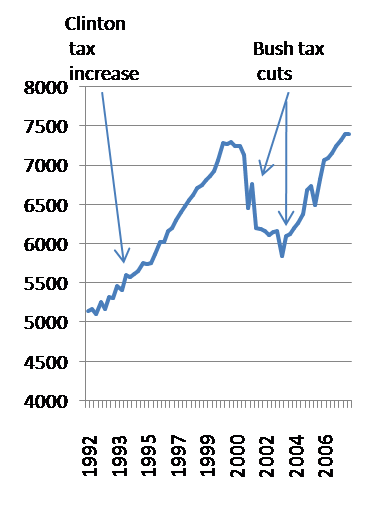
Furthermore, tax revenue is, by and large, the independent variable in this equation. The only government that has absolute control over how much money it gets is a dictatorship. More to the point, changes in tax policy don't have any real long-term effects on tax revenues, which have hovered around 18% of GDP for at least 30 years and probably much longer (here's some historical GDP data for curious readers to play with). George Bush's much-reviled (or much-vaunted, in the right crowd) tax cuts led to a short, sharp fall (>10%) in tax revenues as a percentage of GDP between 2000 and 2004 - but by 2007, revenues were right back on the long-term trend line. The limited effect of political decisions on tax revenues is amply illustrated by this graph from Paul Krugman's 1/16/08 NY Times editorial, "Taxes and revenues - another history lesson." Krugman contends that this graph shows the benefits of increasing taxes, but fails to note that the graph correlates much more closely to GDP than to either Clinton's or Bush's tax policies.
Clearly, tax revenues aren't the problem - they're perhaps the last consistent performer in Washington. Hence I repeat my point: we do not have a budget deficit. Rather, what we have is a spending surplus. Basic economics teaches us that we have limited resources to satisfy unlimited needs; but when politicians can punt scarcity into the national debt, they tend to spend beyond their means in attempting to deliver instant gratification of their constituents' demands. This leads right into the basic tenet of fiscal conservatism: the key to responsible governance is restraint in government spending. In short, the problem isn't how much money government takes in, it's how much money government puts out.
In this sense, the Laffer curve is nothing but trouble for economic conservatives. Here's the core of the problem: the Laffer curve diverts focus from the problem of excessive spending by dangling the dual carrot of lower taxes and higher revenues. Supply-side economics is only useful insofar as it suggests that raising taxes is not necessarily an efficient revenue collection instrument; taken any further, it generally becomes an argument for lower taxes in order to spend more. Hence absurdities like conservatives compromising with liberals by spending money on social programs as well as the war effort; like the "compromise" between tax cuts and increased spending in the recent trillion-dollar stimulus bill; like the generation-old tendency of the opposition party to accuse the majority party of indiscriminate spending, ignoring its own indiscretions when it was the majority party (blatantly evident in both parties over the past three years). Rather than measuring our wish-list against our budget, we measure our budget against our wish-list. Then we wonder how it is that so many people bought houses they couldn't afford to keep, caught up in the dream of a permanent real-estate boom.
But wait, you say. Isn't lower taxation in line with the goals of fiscal conservatism? Well, yes and no. To economic conservatives, lower taxation is a desirable but secondary byproduct of lower spending. This unremarkable revelation came to me when I was thinking about the California budget deficit (see two posts down) and realized that the debate was framed incorrectly.
We don't have a budget deficit. Wait, don't leave, let me explain! The term "budget deficit" implies that the problem is insufficiency; specifically, that tax revenues are insufficient to cover spending programs. But this is an absurd way to view the problem. For starters, tax revenues have consistently increased relative to inflation over any period of time you care to name. Some data: here are historical records of tax revenues over the last 75 years and an inflation calculator. I challenge readers to find any time period 10 years or longer where real tax revenues decreased. Factor in population growth if you like; it doesn't matter. America's government, just like California's, has generally taken in more money from its citizens each year.
Furthermore, tax revenue is, by and large, the independent variable in this equation. The only government that has absolute control over how much money it gets is a dictatorship. More to the point, changes in tax policy don't have any real long-term effects on tax revenues, which have hovered around 18% of GDP for at least 30 years and probably much longer (here's some historical GDP data for curious readers to play with). George Bush's much-reviled (or much-vaunted, in the right crowd) tax cuts led to a short, sharp fall (>10%) in tax revenues as a percentage of GDP between 2000 and 2004 - but by 2007, revenues were right back on the long-term trend line. The limited effect of political decisions on tax revenues is amply illustrated by this graph from Paul Krugman's 1/16/08 NY Times editorial, "Taxes and revenues - another history lesson." Krugman contends that this graph shows the benefits of increasing taxes, but fails to note that the graph correlates much more closely to GDP than to either Clinton's or Bush's tax policies.
Clearly, tax revenues aren't the problem - they're perhaps the last consistent performer in Washington. Hence I repeat my point: we do not have a budget deficit. Rather, what we have is a spending surplus. Basic economics teaches us that we have limited resources to satisfy unlimited needs; but when politicians can punt scarcity into the national debt, they tend to spend beyond their means in attempting to deliver instant gratification of their constituents' demands. This leads right into the basic tenet of fiscal conservatism: the key to responsible governance is restraint in government spending. In short, the problem isn't how much money government takes in, it's how much money government puts out.
In this sense, the Laffer curve is nothing but trouble for economic conservatives. Here's the core of the problem: the Laffer curve diverts focus from the problem of excessive spending by dangling the dual carrot of lower taxes and higher revenues. Supply-side economics is only useful insofar as it suggests that raising taxes is not necessarily an efficient revenue collection instrument; taken any further, it generally becomes an argument for lower taxes in order to spend more. Hence absurdities like conservatives compromising with liberals by spending money on social programs as well as the war effort; like the "compromise" between tax cuts and increased spending in the recent trillion-dollar stimulus bill; like the generation-old tendency of the opposition party to accuse the majority party of indiscriminate spending, ignoring its own indiscretions when it was the majority party (blatantly evident in both parties over the past three years). Rather than measuring our wish-list against our budget, we measure our budget against our wish-list. Then we wonder how it is that so many people bought houses they couldn't afford to keep, caught up in the dream of a permanent real-estate boom.
Tuesday, March 3, 2009
California's Budget Crisis and the Economic Stimulus
My father often tells me that he has only ever seen one graph in the San Jose Mercury News that concisely conveyed relevant information without distortion. The graph was in an article from the late '90s discussing California's budget deficit, and it graphed the California government's inflation-adjusted revenues and expenditures over time. The notable point to be recognized, my father would say, is that although both lines steadily increased as time passed, the line representing expenditures was consistently higher than the line representing tax revenues. California's tax revenues had increased at a rate significantly outstripping inflation, meaning that in any given year, Sacramento politicians had more real resources than the previous year--yet the government's response was simply to keep spending beyond its means. Worse, my father would tell me, California was making long-term spending commitments, out to a decade or more, based on the assumption that these trends would continue, that the tech boom was a permanent phenomenon. This article, said my father, plainly showed the seeds sown for a California crisis down the road.
Of course, I'm not saying my father was some kind of genius just because his prediction is coming true. Anyone with the same information and a basic capacity to reason could have done the same, and many probably did. Still, I have to say, this sounds a lot like what my father's been saying:
I don't really agree with Bill Quick on that last point. The problem with California is that politicians based their spending commitments on the rose-colored glasses theory of economics. They planned based on an eternal boom, and it came back to bite them. Obama, on the other hand, knows the economy's tanking, and he's promoting spending in order to fix it. In other words, rather than being the fuel for spending (as in California), the economy is now the impetus for spending. As such, I don't think it's fair to say that Obama and the CA legislature are touting the same solution, because they've been working on different problems.
However, it is telling that when the economy was booming in California, the answer from the left was increases in social spending on education and healthcare, coupled with tightened environmental regulation under the recently established California EPA. And here is Obama's analysis of the economic crisis, taken from his recent not-State-of-the-Union speech to Congress:
(emphasis mine)
So Obama advocates increased spending on education, healthcare and the environment as partial solutions to the crisis (even accepting the nebulous connection between the former and the latter), while California Democrats advocate increased spending on education, healthcare and the environment as something to do with cash from boom times. It's almost as if their drive for this social spending is completely indifferent to economic concerns, and all the wailing and gnashing of teeth over the economic crisis is just a means to push through the left-wing political agenda. "Never let a good crisis go to waste" and all that.
Of course, I'm not saying my father was some kind of genius just because his prediction is coming true. Anyone with the same information and a basic capacity to reason could have done the same, and many probably did. Still, I have to say, this sounds a lot like what my father's been saying:
California spends far more than it takes in, despite having some of the highest taxes in the United States. It is hostile to business, and the middle class is fleeing in droves. It runs huge deficits every year, yet the Dem dominated legislature refuses to do anything effective to cut spending.
Now one in ten Californians is unemployed. Does any of this sound familiar? It should. It’s what Obama and the Democrats have in mind as a “solution” for the rest of the country.
I don't really agree with Bill Quick on that last point. The problem with California is that politicians based their spending commitments on the rose-colored glasses theory of economics. They planned based on an eternal boom, and it came back to bite them. Obama, on the other hand, knows the economy's tanking, and he's promoting spending in order to fix it. In other words, rather than being the fuel for spending (as in California), the economy is now the impetus for spending. As such, I don't think it's fair to say that Obama and the CA legislature are touting the same solution, because they've been working on different problems.
However, it is telling that when the economy was booming in California, the answer from the left was increases in social spending on education and healthcare, coupled with tightened environmental regulation under the recently established California EPA. And here is Obama's analysis of the economic crisis, taken from his recent not-State-of-the-Union speech to Congress:
The fact is, our economy did not fall into decline overnight. Nor did all of our problems begin when the housing market collapsed or the stock market sank. We have known for decades that our survival depends on finding new sources of energy. Yet we import more oil today than ever before. The cost of health care eats up more and more of our savings each year, yet we keep delaying reform. Our children will compete for jobs in a global economy that too many of our schools do not prepare them for. And though all these challenges went unsolved, we still managed to spend more money and pile up more debt, both as individuals and through our government, than ever before.
(emphasis mine)
So Obama advocates increased spending on education, healthcare and the environment as partial solutions to the crisis (even accepting the nebulous connection between the former and the latter), while California Democrats advocate increased spending on education, healthcare and the environment as something to do with cash from boom times. It's almost as if their drive for this social spending is completely indifferent to economic concerns, and all the wailing and gnashing of teeth over the economic crisis is just a means to push through the left-wing political agenda. "Never let a good crisis go to waste" and all that.
Saturday, January 31, 2009
A Working Government
"The question we ask today is not whether our government is too big or too small, but whether it works."
Volokh Conspiracy's Ilya Somin writes a thoughtful post with this quotation from Obama's inauguration speech as the vehicle. Professor Somin argues that "[Government] has systematic flaws that justify a presumption against it," basically defending the virtues of small government. It's a great piece of work, and Volokh has a great comment culture, so read the whole thing. However, I think Somin passes over the fundamental problem with this statement, with only a passing reference to what I consider its biggest flaw: "Who could possibly be against government when it 'works'?"
My problem with Obama's statement is not that it has no general presumption about limiting government power, but rather that it has no general presumptions at all. The only positive declaration implied by the statement is that what "works" is important; but without any idea of what "working" is, how are we the listeners supposed to learn anything from this statement? Without any semantic content in the statement, listeners are free to attach any interpretation they want to it, making Obama into a tabula rasa for everyone's hopes and fears. Everyone's in favor of things working; the problem is that nobody can agree on how best to arrive at the "working" conclusion. Obama's statement, like many before it, expresses the obvious and skips all the controversy that comes attached.
For reference, here is the full transcript of Obama's inaugural address. The statement in question can be found on page 2.
Volokh Conspiracy's Ilya Somin writes a thoughtful post with this quotation from Obama's inauguration speech as the vehicle. Professor Somin argues that "[Government] has systematic flaws that justify a presumption against it," basically defending the virtues of small government. It's a great piece of work, and Volokh has a great comment culture, so read the whole thing. However, I think Somin passes over the fundamental problem with this statement, with only a passing reference to what I consider its biggest flaw: "Who could possibly be against government when it 'works'?"
My problem with Obama's statement is not that it has no general presumption about limiting government power, but rather that it has no general presumptions at all. The only positive declaration implied by the statement is that what "works" is important; but without any idea of what "working" is, how are we the listeners supposed to learn anything from this statement? Without any semantic content in the statement, listeners are free to attach any interpretation they want to it, making Obama into a tabula rasa for everyone's hopes and fears. Everyone's in favor of things working; the problem is that nobody can agree on how best to arrive at the "working" conclusion. Obama's statement, like many before it, expresses the obvious and skips all the controversy that comes attached.
For reference, here is the full transcript of Obama's inaugural address. The statement in question can be found on page 2.
Saturday, November 22, 2008
VI Day
Zombietime wishes to commemorate the remarkable progress in the last year or so in Iraq by setting today, the 22nd of November, as Victory in Iraq day. I agree, but read the whole thing.
Wednesday, November 5, 2008
Where next?
From Representative Jeff Flake (R-AZ), via The Volokh Conspiracy, comes an agenda for Republicans in the wake of the '08 elections:
To make the obvious pun, Flake's no flake; that was a good message. A few problems, though:
The first problem that I spot with this is that earmarks are essentially irrelevant numbers-wise. Regardless of the moral high ground of being anti-pork, it's hard to get excited when one of the main pillars of a platform is "just" $17 billion, 2% of the nation's discretionary spending. Eliminating all of them would just barely keep the budget flat for one year. Without a better reason to make this an issue, the GOP should just leave it alone - all the more so since 2000-2006 saw so much GOP earmarking that their credibility is ruined on the issue. It seems like an issue that should only be pursued once the GOP wins back a majority - then an anti-earmark stance will actually carry some weight. Don't put the horse before the carrot, so to speak.
Second problem: when a conservative talks about free-market principles, voters will think "deregulation." And when they think of deregulation, they will connect it rightly or wrongly to the financial crisis. That's not a platform anyone can win on.
Third problem: by putting the Second Amendment right next to "strong national defense," Flake plays right into a fundamental paradox of the right wing that many voters see: that while conservatism is about limited government, conservatives often push for a stronger government and the curtailment of absolute freedom in the interest of security. When I say "curtailment of absolute freedom," I don't mean that Big Brother is now watching you and a wrong word will get you carted off to prison; I mean that the right wing will support legislation establishing the potential for a Big Brother system in times of conflict. Yes, the economy is important, perhaps more so than anything else from a strictly political standpoint. But if the Republican Party wants to reestablish credibility, it needs to start by explaining the seeming contradictions in its platform, and this is perhaps the biggest of them all. After we've established that the platform is consistent, THEN we can move on to consistently living up to it.
Update: On Volokh Conspiracy, this comment by Richard Aubrey caught my eye:
I hadn't thought of this at all. By using earmarks, the argument goes, Congressmen are able to break the political process and so get much more damaging legislation passed. I'd like to see some examples of this, but there's the potential to make earmarks a significant issue here. 'Course, the fact that this is the first I've heard of this line of thought shows how poorly anti-porkers are selling it...
I suggest that we return to first principles. At the top of that list has to be a recommitment to limited government. After eight years of profligate spending and soaring deficits, voters can be forgiven for not knowing that limited government has long been the first article of faith for Republicans.
Of course, it's not the level of spending that gets the most attention; it's the manner in which the spending is allocated. The proliferation of earmarks is largely a product of the Gingrich-DeLay years, and it's no surprise that some of the most ardent practitioners were earmarked by the voters for retirement yesterday. Few Americans will take seriously Republican speeches on limited government if we Republicans can't wean ourselves from this insidious practice. But if we can go clean, it will offer a stark contrast to the Democrats, who, after two years in training, already have their own earmark favor factory running at full tilt.
Second, we need to recommit to our belief in economic freedom. Adam Smith's "The Wealth of Nations" may be on the discount rack this year, but the free market is still the most efficient means to allocate capital and human resources in an economy, and Americans know it. Now that we've inserted government deeply into the private sector by bailing out banks and businesses, the temptation will be for government to overstay its welcome and force the distribution of resources to serve political ends. Substituting political for economic incentives is not the recipe for economic recovery. . . .
There are, of course, other pillars of the Republican standard -- strong national defense, support for traditional values and the Second Amendment -- but these are not areas where voters question Republican bona fides. In any event, as we have seen over the past several months, economic woes tend to subsume other concerns. We shouldn't complain. We can now play our strongest hand.
To make the obvious pun, Flake's no flake; that was a good message. A few problems, though:
The first problem that I spot with this is that earmarks are essentially irrelevant numbers-wise. Regardless of the moral high ground of being anti-pork, it's hard to get excited when one of the main pillars of a platform is "just" $17 billion, 2% of the nation's discretionary spending. Eliminating all of them would just barely keep the budget flat for one year. Without a better reason to make this an issue, the GOP should just leave it alone - all the more so since 2000-2006 saw so much GOP earmarking that their credibility is ruined on the issue. It seems like an issue that should only be pursued once the GOP wins back a majority - then an anti-earmark stance will actually carry some weight. Don't put the horse before the carrot, so to speak.
Second problem: when a conservative talks about free-market principles, voters will think "deregulation." And when they think of deregulation, they will connect it rightly or wrongly to the financial crisis. That's not a platform anyone can win on.
Third problem: by putting the Second Amendment right next to "strong national defense," Flake plays right into a fundamental paradox of the right wing that many voters see: that while conservatism is about limited government, conservatives often push for a stronger government and the curtailment of absolute freedom in the interest of security. When I say "curtailment of absolute freedom," I don't mean that Big Brother is now watching you and a wrong word will get you carted off to prison; I mean that the right wing will support legislation establishing the potential for a Big Brother system in times of conflict. Yes, the economy is important, perhaps more so than anything else from a strictly political standpoint. But if the Republican Party wants to reestablish credibility, it needs to start by explaining the seeming contradictions in its platform, and this is perhaps the biggest of them all. After we've established that the platform is consistent, THEN we can move on to consistently living up to it.
Update: On Volokh Conspiracy, this comment by Richard Aubrey caught my eye:
The earmarks are the key, the bribe, to get legislators to vote the required way, on the big things. A key doesn't weigh much, but heavy doors can be unlocked.
I hadn't thought of this at all. By using earmarks, the argument goes, Congressmen are able to break the political process and so get much more damaging legislation passed. I'd like to see some examples of this, but there's the potential to make earmarks a significant issue here. 'Course, the fact that this is the first I've heard of this line of thought shows how poorly anti-porkers are selling it...
Sunday, August 24, 2008
Why does it matter when life begins?
Wow, it's been a while. One would think I'd have spent MORE time thinking about blogs over the summer and LESS during the school year, but such are the contradictions of teenage life.
Another vague, half-formed thought I've been masticating crystallized as I viewed the comment thread of this post over at Hot Air. The post itself castigates Pelosi for her poor attempt to reconcile her pro-abortion stance with her Catholicism (not that I care, since I'm not Catholic), so of course the comment thread walks through the whole abortion debate again.
The only part of the abortion debate I'm interested in is the "murder of an unborn child" question. After all, that IS the deciding factor of the debate. If abortion is indeed murder, that obviously outweighs any considerations about women's freedom and so on, and the pro-lifers carry the day. If not, then the idealistic argument of a woman's right to choose (even if I often feel that it should be a choice of whether or not to have sex rather than a choice of whether or not to get an abortion) and the practical argument that the government has no business legislating the issue will outweigh any moral arguments the right can muster. A lot of people have gotten this far, which is why one so often hears the question, "when does human life begin?" For many, that question was answered by the Pope in 1869, when he announced that the cutoff mark was conception. This is the foundation of many a pro-lifer's position on abortion.
But upon looking at the issue, I was confounded by the question you see up top. Why is it that the primary factor everyone thinks of is life? Bacteria are alive, broccoli are alive, cows are alive, yet few have any compunction about ending the life of these creatures. More to the point, my arm is alive; the cells in my kidney are alive; that tumor that had to be cut out of my aunt Louise was alive, and human to boot, but we have no moral qualms about amputation or kidney removal or chemotherapy. When it comes to defining the boundaries of murder, "life" and "human" seem wholly inadequate. For the true crime of murder is not the death of the cells comprising a human being, but the death of the mind (to the religious, the "soul") that resides within.
That's why, to me, the relevant word is "consciousness". When Mazer Rackham describes the buggers' clearing of Eros to Ender, he makes sure to mention that the buggers don't see what they did as murder. As a hive race, they expected to encounter another such; what they did was "trimming", not murder. By the same token, until the foetus reaches independent consciousness, it's naught but a part of the mother, and the mother can decide to remove it if she wants.
Don't confuse this with the "personhood" criteria that one can find on Wikipedia. I do not require that a foetus be able to tell the world, "I think, therefore I am," to be a person. The minimum standard for consciousness, according to the few websites I've visited that discuss the subject, appears to be the ability to feel pain, which develops around the 26th week (regardless of when the foetus starts actually feeling pain). So in my opinion, till then, the mother can do what she darn well pleases; afterwards, she should treat the foetus with all the respect she would give any other living human being. Which may not be much, but it's a start.
EDIT: Both Alioth, here, and BKennedy at Hot Air have pointed out that the potential for consciousness could be used as an alternative cutoff point, and one that would establish the sanctity of the foetus from conception (since this standard requires that the entity in question would do so if left alone, we can ignore gametes, since they must first find another gamete to reach this stage). Also, Think_B4_Speaking at Hot Air has offered a second possible milestone for the establishment of independent consciousness, namely the point when the foetus' brain waves begin registering (around week 11), which would change the cutoff point to near the end of the first trimester.
Finally, a couple of clarifications:
1. "Independent consciousness" does not mean that the foetus be self-sufficient or awake, merely that it have a "self" which is separate from the mother.
2. I am not trying to equate cancer cells with human foetuses (foeti? heh). However, both of them are alive, human, and genetically unique, thereby disqualifying those three criteria from consideration. Obviously a foetus either has independent consciousness, or it has the potential for such, while tumors have neither, so we're right back to those two criteria.
3. When I draw a line, I draw a line. I don't draw a slippery slope. So please, no comments about how next I'll be excluding female foetuses, or foetuses with Down's Syndrome, or gay foetuses (and how am I supposed to tell that last, anyway?). None of these characteristics become apparent until after brain waves begin registering, anyway, so the point is moot.
Another vague, half-formed thought I've been masticating crystallized as I viewed the comment thread of this post over at Hot Air. The post itself castigates Pelosi for her poor attempt to reconcile her pro-abortion stance with her Catholicism (not that I care, since I'm not Catholic), so of course the comment thread walks through the whole abortion debate again.
The only part of the abortion debate I'm interested in is the "murder of an unborn child" question. After all, that IS the deciding factor of the debate. If abortion is indeed murder, that obviously outweighs any considerations about women's freedom and so on, and the pro-lifers carry the day. If not, then the idealistic argument of a woman's right to choose (even if I often feel that it should be a choice of whether or not to have sex rather than a choice of whether or not to get an abortion) and the practical argument that the government has no business legislating the issue will outweigh any moral arguments the right can muster. A lot of people have gotten this far, which is why one so often hears the question, "when does human life begin?" For many, that question was answered by the Pope in 1869, when he announced that the cutoff mark was conception. This is the foundation of many a pro-lifer's position on abortion.
But upon looking at the issue, I was confounded by the question you see up top. Why is it that the primary factor everyone thinks of is life? Bacteria are alive, broccoli are alive, cows are alive, yet few have any compunction about ending the life of these creatures. More to the point, my arm is alive; the cells in my kidney are alive; that tumor that had to be cut out of my aunt Louise was alive, and human to boot, but we have no moral qualms about amputation or kidney removal or chemotherapy. When it comes to defining the boundaries of murder, "life" and "human" seem wholly inadequate. For the true crime of murder is not the death of the cells comprising a human being, but the death of the mind (to the religious, the "soul") that resides within.
That's why, to me, the relevant word is "consciousness". When Mazer Rackham describes the buggers' clearing of Eros to Ender, he makes sure to mention that the buggers don't see what they did as murder. As a hive race, they expected to encounter another such; what they did was "trimming", not murder. By the same token, until the foetus reaches independent consciousness, it's naught but a part of the mother, and the mother can decide to remove it if she wants.
Don't confuse this with the "personhood" criteria that one can find on Wikipedia. I do not require that a foetus be able to tell the world, "I think, therefore I am," to be a person. The minimum standard for consciousness, according to the few websites I've visited that discuss the subject, appears to be the ability to feel pain, which develops around the 26th week (regardless of when the foetus starts actually feeling pain). So in my opinion, till then, the mother can do what she darn well pleases; afterwards, she should treat the foetus with all the respect she would give any other living human being. Which may not be much, but it's a start.
EDIT: Both Alioth, here, and BKennedy at Hot Air have pointed out that the potential for consciousness could be used as an alternative cutoff point, and one that would establish the sanctity of the foetus from conception (since this standard requires that the entity in question would do so if left alone, we can ignore gametes, since they must first find another gamete to reach this stage). Also, Think_B4_Speaking at Hot Air has offered a second possible milestone for the establishment of independent consciousness, namely the point when the foetus' brain waves begin registering (around week 11), which would change the cutoff point to near the end of the first trimester.
Finally, a couple of clarifications:
1. "Independent consciousness" does not mean that the foetus be self-sufficient or awake, merely that it have a "self" which is separate from the mother.
2. I am not trying to equate cancer cells with human foetuses (foeti? heh). However, both of them are alive, human, and genetically unique, thereby disqualifying those three criteria from consideration. Obviously a foetus either has independent consciousness, or it has the potential for such, while tumors have neither, so we're right back to those two criteria.
3. When I draw a line, I draw a line. I don't draw a slippery slope. So please, no comments about how next I'll be excluding female foetuses, or foetuses with Down's Syndrome, or gay foetuses (and how am I supposed to tell that last, anyway?). None of these characteristics become apparent until after brain waves begin registering, anyway, so the point is moot.
Subscribe to:
Posts (Atom)

 Posts
Posts