Showing posts with label Economy. Show all posts
Showing posts with label Economy. Show all posts
Saturday, May 11, 2013

Monday, April 16, 2012
Robert Reich: Taxing the Wealthy Essential to Growing Economy
Robert Reich attacks the perceived tradeoff between increasing the progressiveness of the income tax and economic growth. tax and economic growth. I would nitpick that he fails to note the difference in real income between the lower end of the top marginal tax rate in the post-WWII era and now (~$2 million vs. ~$400,000 in today's money). I also wonder whether the comparison with Germany is truly apt, given the broader state of the Eurozone. However, I can't help but agree with the basic point: progressive taxation used to provide public goods and stimulate the middle class will benefit the economy more than having surplus wealth concentrated in the hands of a few speculators and investors.
Wednesday, April 4, 2012
Grade Averaging as an Allegory for Liberal Politics? Think Again
This is an oft-repeated story, and I'd like to take some time to cut it down to size.
First, let's address the central fallacy of the allegory: the dichotomy between equal opportunity and equal outcomes. Do you believe that the current state of income inequality is a problem in the United States? I'm guessing most people answer in the affirmative. Now, do you believe that NO ONE should be poor and NO ONE should be rich? Far fewer hands raised. Do you believe that everyone should receive the same income regardless of work done and value added? Nary a "yes" to be found. Yet this is the premise of the allegory. A false premise: that "Obama socialism" implies entirely equal outcomes.
Let's look at the lessons we're supposed to draw from this allegory.
"1. You cannot legislate the poor into prosperity by legislating the wealthy out of prosperity." Fortunately for everyone, we're not trying to do either.
"2. What one person receives without working for, another person must work for without receiving." Blatantly false. If one person is taxed and two people use the resulting road, both benefit.
"3. The government cannot give to anybody anything that the government does not first take from somebody else." But that’s certainly not a reason to never take anything from anybody. Sometimes, “He needs it more” is a valid argument. Then, too, the government is also capable of creating value. From research funding to education to infrastructure, society is littered with examples of this.
“4. You cannot multiply wealth by dividing it!” Disregarding the technical innumeracy of regarding division and multiplication as fundamentally different, I would counter by saying that multiplying the wealth of the wealthy alone is not the best solution.
“5. When half of the people get the idea that they do not have to work because the other half is going to take care of them, and the other half gets the idea that it does no good to work because somebody else is going to get what they worked for, that is the beginning of the end of any nation.” There’s rather a gap between eliminating all incentives to work and eliminating all stopgap measures for those who cannot work, or cannot feed themselves, or can’t receive adequate medical treatment (the factors that contribute to absurd American healthcare costs are a subject I’ll discuss another time). I’d like to think we should fall somewhere in between.
I don’t agree with everything Obama does. Hell, I don’t even agree with most of what he does. But that’s all the more reason not to make up nonsensical stories upon which to base my disagreement. No?
‘The Obama Experiment’ Causes Economics Professor to Fail Entire Class
An economics professor at a local college made a statement that he had never failed a single student before, but had recently failed an entire class. That class had insisted that Obama’s socialism worked and that no one would be poor and no one would be rich, a great equalizer.
The professor then said, “OK, we will have an experiment in this class on Obama’s plan”. All grades will be averaged and everyone will receive the same grade so no one will fail and no one will receive an A…. (substituting grades for dollars – something closer to home and more readily understood by all).
After the first test, the grades were averaged and everyone got a B. The students who studied hard were upset and the students who studied little were happy. As the second test rolled around, the students who studied little had studied even less and the ones who studied hard decided they wanted a free ride too so they studied little..
The second test average was a D! No one was happy. When the 3rd test rolled around, the average was an F. As the tests proceeded, the scores never increased as bickering, blame and name-calling all resulted in hard feelings and no one would study for the benefit of anyone else. To their great surprise, ALL FAILED and the professor told them that socialism would also ultimately fail because when the reward is great, the effort to succeed is great, but when government takes all the reward away, no one will try or want to succeed. It could not be any simpler than that.
First, let's address the central fallacy of the allegory: the dichotomy between equal opportunity and equal outcomes. Do you believe that the current state of income inequality is a problem in the United States? I'm guessing most people answer in the affirmative. Now, do you believe that NO ONE should be poor and NO ONE should be rich? Far fewer hands raised. Do you believe that everyone should receive the same income regardless of work done and value added? Nary a "yes" to be found. Yet this is the premise of the allegory. A false premise: that "Obama socialism" implies entirely equal outcomes.
Let's look at the lessons we're supposed to draw from this allegory.
"1. You cannot legislate the poor into prosperity by legislating the wealthy out of prosperity." Fortunately for everyone, we're not trying to do either.
"2. What one person receives without working for, another person must work for without receiving." Blatantly false. If one person is taxed and two people use the resulting road, both benefit.
"3. The government cannot give to anybody anything that the government does not first take from somebody else." But that’s certainly not a reason to never take anything from anybody. Sometimes, “He needs it more” is a valid argument. Then, too, the government is also capable of creating value. From research funding to education to infrastructure, society is littered with examples of this.
“4. You cannot multiply wealth by dividing it!” Disregarding the technical innumeracy of regarding division and multiplication as fundamentally different, I would counter by saying that multiplying the wealth of the wealthy alone is not the best solution.
“5. When half of the people get the idea that they do not have to work because the other half is going to take care of them, and the other half gets the idea that it does no good to work because somebody else is going to get what they worked for, that is the beginning of the end of any nation.” There’s rather a gap between eliminating all incentives to work and eliminating all stopgap measures for those who cannot work, or cannot feed themselves, or can’t receive adequate medical treatment (the factors that contribute to absurd American healthcare costs are a subject I’ll discuss another time). I’d like to think we should fall somewhere in between.
I don’t agree with everything Obama does. Hell, I don’t even agree with most of what he does. But that’s all the more reason not to make up nonsensical stories upon which to base my disagreement. No?
Tuesday, March 20, 2012
Education and Progress
Progress has high marginal educational costs. As a society becomes more dependent on scientific, technical, and technological developments, people within that society must shoulder a greater burden of prerequisite knowledge to be informed citizens and skilled workers. The educational phase of life is correspondingly lengthened, which cuts into productive work life and increases the financial barrier to educational qualifications (especially since the added phases of education are more likely to require expensive facilities).
Counterbalancing this, of course, is that more developed societies have more money to spend on this kind of thing. Technological development also extends productive work life at the other end. And technology may give us tools to accelerate educational development--to pull a random example from thin air, with global interconnectivity it's much easier to get exposure to a foreign language, and with online learning it's incredibly easy to find and study material up to and including college-level coursework in technical fields. I feel that the latter point in particular is something that our society hasn't taken advantage of to nearly the degree that is possible. Indeed, it seems that rather than accelerating, education is more and more about not falling behind. That's rather unfortunate.
As always, spoken with little experiential context, and I welcome--indeed, I hope for--comments from people who know more.
Counterbalancing this, of course, is that more developed societies have more money to spend on this kind of thing. Technological development also extends productive work life at the other end. And technology may give us tools to accelerate educational development--to pull a random example from thin air, with global interconnectivity it's much easier to get exposure to a foreign language, and with online learning it's incredibly easy to find and study material up to and including college-level coursework in technical fields. I feel that the latter point in particular is something that our society hasn't taken advantage of to nearly the degree that is possible. Indeed, it seems that rather than accelerating, education is more and more about not falling behind. That's rather unfortunate.
As always, spoken with little experiential context, and I welcome--indeed, I hope for--comments from people who know more.
Sunday, March 8, 2009
How the Laffer Curve fundamentally undermined fiscal conservatism
Just about everyone knows the basic idea behind the Laffer curve: at both 0% and 100% taxation, the government gets no tax revenues, meaning that decreasing taxes can theoretically lead to increased revenues. The resultant theory of supply-side economics helped catapult Ronald Reagan to the Presidency in the 1980s, and controlled GOP economic policy for a generation. It also crippled economic conservatism on the national stage, perhaps beyond our ability to heal.
But wait, you say. Isn't lower taxation in line with the goals of fiscal conservatism? Well, yes and no. To economic conservatives, lower taxation is a desirable but secondary byproduct of lower spending. This unremarkable revelation came to me when I was thinking about the California budget deficit (see two posts down) and realized that the debate was framed incorrectly.
We don't have a budget deficit. Wait, don't leave, let me explain! The term "budget deficit" implies that the problem is insufficiency; specifically, that tax revenues are insufficient to cover spending programs. But this is an absurd way to view the problem. For starters, tax revenues have consistently increased relative to inflation over any period of time you care to name. Some data: here are historical records of tax revenues over the last 75 years and an inflation calculator. I challenge readers to find any time period 10 years or longer where real tax revenues decreased. Factor in population growth if you like; it doesn't matter. America's government, just like California's, has generally taken in more money from its citizens each year.
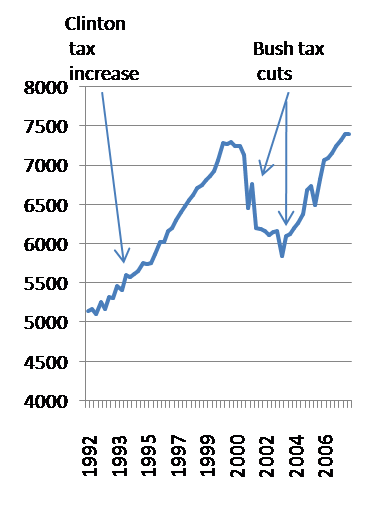
Furthermore, tax revenue is, by and large, the independent variable in this equation. The only government that has absolute control over how much money it gets is a dictatorship. More to the point, changes in tax policy don't have any real long-term effects on tax revenues, which have hovered around 18% of GDP for at least 30 years and probably much longer (here's some historical GDP data for curious readers to play with). George Bush's much-reviled (or much-vaunted, in the right crowd) tax cuts led to a short, sharp fall (>10%) in tax revenues as a percentage of GDP between 2000 and 2004 - but by 2007, revenues were right back on the long-term trend line. The limited effect of political decisions on tax revenues is amply illustrated by this graph from Paul Krugman's 1/16/08 NY Times editorial, "Taxes and revenues - another history lesson." Krugman contends that this graph shows the benefits of increasing taxes, but fails to note that the graph correlates much more closely to GDP than to either Clinton's or Bush's tax policies.
Clearly, tax revenues aren't the problem - they're perhaps the last consistent performer in Washington. Hence I repeat my point: we do not have a budget deficit. Rather, what we have is a spending surplus. Basic economics teaches us that we have limited resources to satisfy unlimited needs; but when politicians can punt scarcity into the national debt, they tend to spend beyond their means in attempting to deliver instant gratification of their constituents' demands. This leads right into the basic tenet of fiscal conservatism: the key to responsible governance is restraint in government spending. In short, the problem isn't how much money government takes in, it's how much money government puts out.
In this sense, the Laffer curve is nothing but trouble for economic conservatives. Here's the core of the problem: the Laffer curve diverts focus from the problem of excessive spending by dangling the dual carrot of lower taxes and higher revenues. Supply-side economics is only useful insofar as it suggests that raising taxes is not necessarily an efficient revenue collection instrument; taken any further, it generally becomes an argument for lower taxes in order to spend more. Hence absurdities like conservatives compromising with liberals by spending money on social programs as well as the war effort; like the "compromise" between tax cuts and increased spending in the recent trillion-dollar stimulus bill; like the generation-old tendency of the opposition party to accuse the majority party of indiscriminate spending, ignoring its own indiscretions when it was the majority party (blatantly evident in both parties over the past three years). Rather than measuring our wish-list against our budget, we measure our budget against our wish-list. Then we wonder how it is that so many people bought houses they couldn't afford to keep, caught up in the dream of a permanent real-estate boom.
But wait, you say. Isn't lower taxation in line with the goals of fiscal conservatism? Well, yes and no. To economic conservatives, lower taxation is a desirable but secondary byproduct of lower spending. This unremarkable revelation came to me when I was thinking about the California budget deficit (see two posts down) and realized that the debate was framed incorrectly.
We don't have a budget deficit. Wait, don't leave, let me explain! The term "budget deficit" implies that the problem is insufficiency; specifically, that tax revenues are insufficient to cover spending programs. But this is an absurd way to view the problem. For starters, tax revenues have consistently increased relative to inflation over any period of time you care to name. Some data: here are historical records of tax revenues over the last 75 years and an inflation calculator. I challenge readers to find any time period 10 years or longer where real tax revenues decreased. Factor in population growth if you like; it doesn't matter. America's government, just like California's, has generally taken in more money from its citizens each year.
Furthermore, tax revenue is, by and large, the independent variable in this equation. The only government that has absolute control over how much money it gets is a dictatorship. More to the point, changes in tax policy don't have any real long-term effects on tax revenues, which have hovered around 18% of GDP for at least 30 years and probably much longer (here's some historical GDP data for curious readers to play with). George Bush's much-reviled (or much-vaunted, in the right crowd) tax cuts led to a short, sharp fall (>10%) in tax revenues as a percentage of GDP between 2000 and 2004 - but by 2007, revenues were right back on the long-term trend line. The limited effect of political decisions on tax revenues is amply illustrated by this graph from Paul Krugman's 1/16/08 NY Times editorial, "Taxes and revenues - another history lesson." Krugman contends that this graph shows the benefits of increasing taxes, but fails to note that the graph correlates much more closely to GDP than to either Clinton's or Bush's tax policies.
Clearly, tax revenues aren't the problem - they're perhaps the last consistent performer in Washington. Hence I repeat my point: we do not have a budget deficit. Rather, what we have is a spending surplus. Basic economics teaches us that we have limited resources to satisfy unlimited needs; but when politicians can punt scarcity into the national debt, they tend to spend beyond their means in attempting to deliver instant gratification of their constituents' demands. This leads right into the basic tenet of fiscal conservatism: the key to responsible governance is restraint in government spending. In short, the problem isn't how much money government takes in, it's how much money government puts out.
In this sense, the Laffer curve is nothing but trouble for economic conservatives. Here's the core of the problem: the Laffer curve diverts focus from the problem of excessive spending by dangling the dual carrot of lower taxes and higher revenues. Supply-side economics is only useful insofar as it suggests that raising taxes is not necessarily an efficient revenue collection instrument; taken any further, it generally becomes an argument for lower taxes in order to spend more. Hence absurdities like conservatives compromising with liberals by spending money on social programs as well as the war effort; like the "compromise" between tax cuts and increased spending in the recent trillion-dollar stimulus bill; like the generation-old tendency of the opposition party to accuse the majority party of indiscriminate spending, ignoring its own indiscretions when it was the majority party (blatantly evident in both parties over the past three years). Rather than measuring our wish-list against our budget, we measure our budget against our wish-list. Then we wonder how it is that so many people bought houses they couldn't afford to keep, caught up in the dream of a permanent real-estate boom.
Tuesday, March 3, 2009
California's Budget Crisis and the Economic Stimulus
My father often tells me that he has only ever seen one graph in the San Jose Mercury News that concisely conveyed relevant information without distortion. The graph was in an article from the late '90s discussing California's budget deficit, and it graphed the California government's inflation-adjusted revenues and expenditures over time. The notable point to be recognized, my father would say, is that although both lines steadily increased as time passed, the line representing expenditures was consistently higher than the line representing tax revenues. California's tax revenues had increased at a rate significantly outstripping inflation, meaning that in any given year, Sacramento politicians had more real resources than the previous year--yet the government's response was simply to keep spending beyond its means. Worse, my father would tell me, California was making long-term spending commitments, out to a decade or more, based on the assumption that these trends would continue, that the tech boom was a permanent phenomenon. This article, said my father, plainly showed the seeds sown for a California crisis down the road.
Of course, I'm not saying my father was some kind of genius just because his prediction is coming true. Anyone with the same information and a basic capacity to reason could have done the same, and many probably did. Still, I have to say, this sounds a lot like what my father's been saying:
I don't really agree with Bill Quick on that last point. The problem with California is that politicians based their spending commitments on the rose-colored glasses theory of economics. They planned based on an eternal boom, and it came back to bite them. Obama, on the other hand, knows the economy's tanking, and he's promoting spending in order to fix it. In other words, rather than being the fuel for spending (as in California), the economy is now the impetus for spending. As such, I don't think it's fair to say that Obama and the CA legislature are touting the same solution, because they've been working on different problems.
However, it is telling that when the economy was booming in California, the answer from the left was increases in social spending on education and healthcare, coupled with tightened environmental regulation under the recently established California EPA. And here is Obama's analysis of the economic crisis, taken from his recent not-State-of-the-Union speech to Congress:
(emphasis mine)
So Obama advocates increased spending on education, healthcare and the environment as partial solutions to the crisis (even accepting the nebulous connection between the former and the latter), while California Democrats advocate increased spending on education, healthcare and the environment as something to do with cash from boom times. It's almost as if their drive for this social spending is completely indifferent to economic concerns, and all the wailing and gnashing of teeth over the economic crisis is just a means to push through the left-wing political agenda. "Never let a good crisis go to waste" and all that.
Of course, I'm not saying my father was some kind of genius just because his prediction is coming true. Anyone with the same information and a basic capacity to reason could have done the same, and many probably did. Still, I have to say, this sounds a lot like what my father's been saying:
California spends far more than it takes in, despite having some of the highest taxes in the United States. It is hostile to business, and the middle class is fleeing in droves. It runs huge deficits every year, yet the Dem dominated legislature refuses to do anything effective to cut spending.
Now one in ten Californians is unemployed. Does any of this sound familiar? It should. It’s what Obama and the Democrats have in mind as a “solution” for the rest of the country.
I don't really agree with Bill Quick on that last point. The problem with California is that politicians based their spending commitments on the rose-colored glasses theory of economics. They planned based on an eternal boom, and it came back to bite them. Obama, on the other hand, knows the economy's tanking, and he's promoting spending in order to fix it. In other words, rather than being the fuel for spending (as in California), the economy is now the impetus for spending. As such, I don't think it's fair to say that Obama and the CA legislature are touting the same solution, because they've been working on different problems.
However, it is telling that when the economy was booming in California, the answer from the left was increases in social spending on education and healthcare, coupled with tightened environmental regulation under the recently established California EPA. And here is Obama's analysis of the economic crisis, taken from his recent not-State-of-the-Union speech to Congress:
The fact is, our economy did not fall into decline overnight. Nor did all of our problems begin when the housing market collapsed or the stock market sank. We have known for decades that our survival depends on finding new sources of energy. Yet we import more oil today than ever before. The cost of health care eats up more and more of our savings each year, yet we keep delaying reform. Our children will compete for jobs in a global economy that too many of our schools do not prepare them for. And though all these challenges went unsolved, we still managed to spend more money and pile up more debt, both as individuals and through our government, than ever before.
(emphasis mine)
So Obama advocates increased spending on education, healthcare and the environment as partial solutions to the crisis (even accepting the nebulous connection between the former and the latter), while California Democrats advocate increased spending on education, healthcare and the environment as something to do with cash from boom times. It's almost as if their drive for this social spending is completely indifferent to economic concerns, and all the wailing and gnashing of teeth over the economic crisis is just a means to push through the left-wing political agenda. "Never let a good crisis go to waste" and all that.
Wednesday, February 27, 2008
Oil's Obvious Solution: Why Isn't it More Noticed?
First, an administrative note: I was so busy with homework that I couldn't do any more of the planned series on the nominees, and now that McCain has wrapped up the Republican nomination further comment on the Republican race is pretty pointless. Later posts will probably tell readers (if there are any at this point) what I think of Hillary, Obama, and McCain, so I'm calling off the series.
Anyway, this post came together for me while I was strolling through Captain Ed's comment section. Having corrected the misconception that Clinton performed an economic miracle (for those who are interested in that discussion, here is the relevant post), I moved on and noticed a post complaining that Exxon pays taxes for a lot of the poor population. This piqued my interest, and while replying my thoughts coalesced into something worthy of a blog post. Here we go:
Oil, as much as food, is a necessity; our nation runs on the stuff. But high gasoline prices have inspired widespread complaints about the evil oil companies who make ungodly profits at the taxpayer's expense. Furthermore, oil's role in carbon dioxide emissions, its limited nature, and its disreputable provider nations (particularly in the Middle East) combine to make it that much more objectionable. Whether or not you believe that oil companies make too much money or that CO2-created AGW exists, oil is not an ideal energy source by any stretch of the imagination, certainly not as THE resource of the United States.
So, what to do about Texas tea? Motivated by dislike verging on hatred for oil companies as well as global warming, the left offers various solutions, which for the sake of simplicity I will divide into two categories: carbon taxes and cap-and-trade systems. As the name indicates, carbon taxes generally tax the hell out of everything that emits a greenhouse gas, including (and probably especially) products that use oil as well as oil companies. The rationale is that creating an economic disincentive will encourage companies to search for other energy sources, plus Congress gets more money (which is a good thing for Congressmen, if not for the rest of the country). Cap-and-trade systems set a limit on the amount that the country can emit, divide up that amount into small units, and hand those units out to companies to sell back and forth until everything balances out. Proponents of this system argue that it sets a clear limit on emissions (as opposed to the gas tax); that it is something of a "free-market" solution that allows companies flexibility in determining their emission rates; that it has been tested successfully on sulfur dioxide emissions, reducing acid rain without a lot of hullabaloo; and that Congress gets money from it (of course). Meanwhile, the Republicans offer the tried-and-true solution of leaving it to Smith's invisible handmobile. Some Republicans simply don't see this as an issue - they don't think AGW is real and don't fault oil companies for making a profit. Others trust that the free market will sort things out - if the oil companies are so eeevil and oil kills babies, surely someone will notice after a while.
However, none of these stock solutions mix well with oil because of the nature of the industry. Carbon taxes are essentially gasoline taxes applied on a broader scale - but the net result would simply be higher prices. Since oil is a necessity, oil companies have a lot more leeway in their pricing than most - they can adjust prices to meet their desired profit margin, and the only real loser in this situation is the consumer. More specifically, the loser is the poor consumer - since taxes on oil companies translate into higher prices at the pump, a carbon tax is essentially the same as the regressive sales tax for oil companies. We can see this in a smaller frame by looking at gasoline taxes, which don't put people off buying gasoline and don't stop companies from making large profits. So that solution doesn't hold up.
Cap-and-trade is more complicated, but still ultimately fails when it comes to controlling oil companies. First, the initial handout of permits is a process seemingly ripe for corruption and havoc, unless there's already a good way to control that process. Assuming the acid rain politicians figured that out, we then move to the effect on oil companies, which is essentially nil as they can purchase permits willy-nilly unless and until the market freezes up as companies attempt to hold on to their remaining credits, which basically destroys the system. And the cost for those permits will once again go straight to the taxpayer.
Finally, the free-market solution will fail (or at least be EXTREMELY slow) because of the dominance of oil. Until a development like the one that allowed us to exploit oil comes along, oil is the best natural resource available. There's technology that allows us to use other resources for the same process, but those are very slow to come together because there's little short-term incentive at the moment to develop it; furthermore, any resource that requires a surrounding infrastructure (like gasoline) will have trouble competing against the well-developed infrastructure that supports oil.
To reuse the chemistry metaphor, the unifying quality of these solutions is that they are polar; they're each developed by one side of the political continuum. Oil, being a nonpolar substance, can only dissolve nonpolar substances; let's try a nonpolar solution. Promote government R&D that develops an incentive for alternative energy sources. The X-Prize worked well for private spacecraft development; something similar can be (and probably is being) done for alternatives to oil in various industries. Using the X-prize model, the left is happy because it helps the environment and hurts the eeeevil oil companies, while the right is happy because it preserves free-market incentives and removes ties with OPEC. Why don't more people talk about this? Is it because it's already done to the degree where more won't help?
Another simple solution, which I was reminded of by a friend: nuclear energy. Apart from the stigma of Chernobyl and the problem of getting rid of nuclear waste (both solvable), is there any reason why we aren't putting more effort into this area?
Anyway, this post came together for me while I was strolling through Captain Ed's comment section. Having corrected the misconception that Clinton performed an economic miracle (for those who are interested in that discussion, here is the relevant post), I moved on and noticed a post complaining that Exxon pays taxes for a lot of the poor population. This piqued my interest, and while replying my thoughts coalesced into something worthy of a blog post. Here we go:
Oil, as much as food, is a necessity; our nation runs on the stuff. But high gasoline prices have inspired widespread complaints about the evil oil companies who make ungodly profits at the taxpayer's expense. Furthermore, oil's role in carbon dioxide emissions, its limited nature, and its disreputable provider nations (particularly in the Middle East) combine to make it that much more objectionable. Whether or not you believe that oil companies make too much money or that CO2-created AGW exists, oil is not an ideal energy source by any stretch of the imagination, certainly not as THE resource of the United States.
So, what to do about Texas tea? Motivated by dislike verging on hatred for oil companies as well as global warming, the left offers various solutions, which for the sake of simplicity I will divide into two categories: carbon taxes and cap-and-trade systems. As the name indicates, carbon taxes generally tax the hell out of everything that emits a greenhouse gas, including (and probably especially) products that use oil as well as oil companies. The rationale is that creating an economic disincentive will encourage companies to search for other energy sources, plus Congress gets more money (which is a good thing for Congressmen, if not for the rest of the country). Cap-and-trade systems set a limit on the amount that the country can emit, divide up that amount into small units, and hand those units out to companies to sell back and forth until everything balances out. Proponents of this system argue that it sets a clear limit on emissions (as opposed to the gas tax); that it is something of a "free-market" solution that allows companies flexibility in determining their emission rates; that it has been tested successfully on sulfur dioxide emissions, reducing acid rain without a lot of hullabaloo; and that Congress gets money from it (of course). Meanwhile, the Republicans offer the tried-and-true solution of leaving it to Smith's invisible handmobile. Some Republicans simply don't see this as an issue - they don't think AGW is real and don't fault oil companies for making a profit. Others trust that the free market will sort things out - if the oil companies are so eeevil and oil kills babies, surely someone will notice after a while.
However, none of these stock solutions mix well with oil because of the nature of the industry. Carbon taxes are essentially gasoline taxes applied on a broader scale - but the net result would simply be higher prices. Since oil is a necessity, oil companies have a lot more leeway in their pricing than most - they can adjust prices to meet their desired profit margin, and the only real loser in this situation is the consumer. More specifically, the loser is the poor consumer - since taxes on oil companies translate into higher prices at the pump, a carbon tax is essentially the same as the regressive sales tax for oil companies. We can see this in a smaller frame by looking at gasoline taxes, which don't put people off buying gasoline and don't stop companies from making large profits. So that solution doesn't hold up.
Cap-and-trade is more complicated, but still ultimately fails when it comes to controlling oil companies. First, the initial handout of permits is a process seemingly ripe for corruption and havoc, unless there's already a good way to control that process. Assuming the acid rain politicians figured that out, we then move to the effect on oil companies, which is essentially nil as they can purchase permits willy-nilly unless and until the market freezes up as companies attempt to hold on to their remaining credits, which basically destroys the system. And the cost for those permits will once again go straight to the taxpayer.
Finally, the free-market solution will fail (or at least be EXTREMELY slow) because of the dominance of oil. Until a development like the one that allowed us to exploit oil comes along, oil is the best natural resource available. There's technology that allows us to use other resources for the same process, but those are very slow to come together because there's little short-term incentive at the moment to develop it; furthermore, any resource that requires a surrounding infrastructure (like gasoline) will have trouble competing against the well-developed infrastructure that supports oil.
To reuse the chemistry metaphor, the unifying quality of these solutions is that they are polar; they're each developed by one side of the political continuum. Oil, being a nonpolar substance, can only dissolve nonpolar substances; let's try a nonpolar solution. Promote government R&D that develops an incentive for alternative energy sources. The X-Prize worked well for private spacecraft development; something similar can be (and probably is being) done for alternatives to oil in various industries. Using the X-prize model, the left is happy because it helps the environment and hurts the eeeevil oil companies, while the right is happy because it preserves free-market incentives and removes ties with OPEC. Why don't more people talk about this? Is it because it's already done to the degree where more won't help?
Another simple solution, which I was reminded of by a friend: nuclear energy. Apart from the stigma of Chernobyl and the problem of getting rid of nuclear waste (both solvable), is there any reason why we aren't putting more effort into this area?
Subscribe to:
Posts (Atom)

 Posts
Posts